The EU, Porn, and Hollywood

And if that title doesn’t attract attention I don’t know what will…

Unfortunately (for you) while this title is accurate the rest of this post may not quite deliver what you are expecting or hoping for. Just a few days ago (Thursday 16th May) I attended for the first time an ISSA-UK chapter meeting in Bristol where Marcus Alldrick, Richard Hollis and myself were presenting (in that order) to the great and the good of the south west infosec community.

Marcus Alldrick emphasises...

Marcus Alldrick emphasises…

Marcus’ presentation of The EU’s Proposed Data Protection Regulation, It’s Life Jim But Not As We Know It was very well received with a huge amount of interaction to the point of a  twenty minute overrun. I have tended to avoid expending too much energy on draft legislation like this as it often changes dramatically the closer it gets to publication (MA201 CMR 17 is a good example of this), and so the view that Marcus presented was a welcome one. Although his deck was content rich he put it across in his own inimitable style and I found it hugely educational. One point that came across loud and clear is that if it gets enacted in its current format one of the most sought after roles in any company will be that of Chief Privacy Officer for the job security alone (the role must be filled by the same person for a minimum of two years!).

...and Richard hills boasts

…and Richard Hollis boasts

Second up was Richard Hollis with his hotly anticipated Deep Threat – Top 10 Lessons to Learn from the Online Adult Entertainment Industry. While the expected jokes and euphemisms came thick and fast underneath it were some startling and very interesting lessons, but namely that the adult entertainment industry simply does information security far better than the rest of us; they are single minded, have a lot to lose, and ultimately see the “battle” with maintaining security as just that… it’s a war which they are determined to win. A fascinating insight into an often overlooked industry with some great lessons summarising the underlying security ethos of this industry.

I'm a little teapot

I’m a little teapot

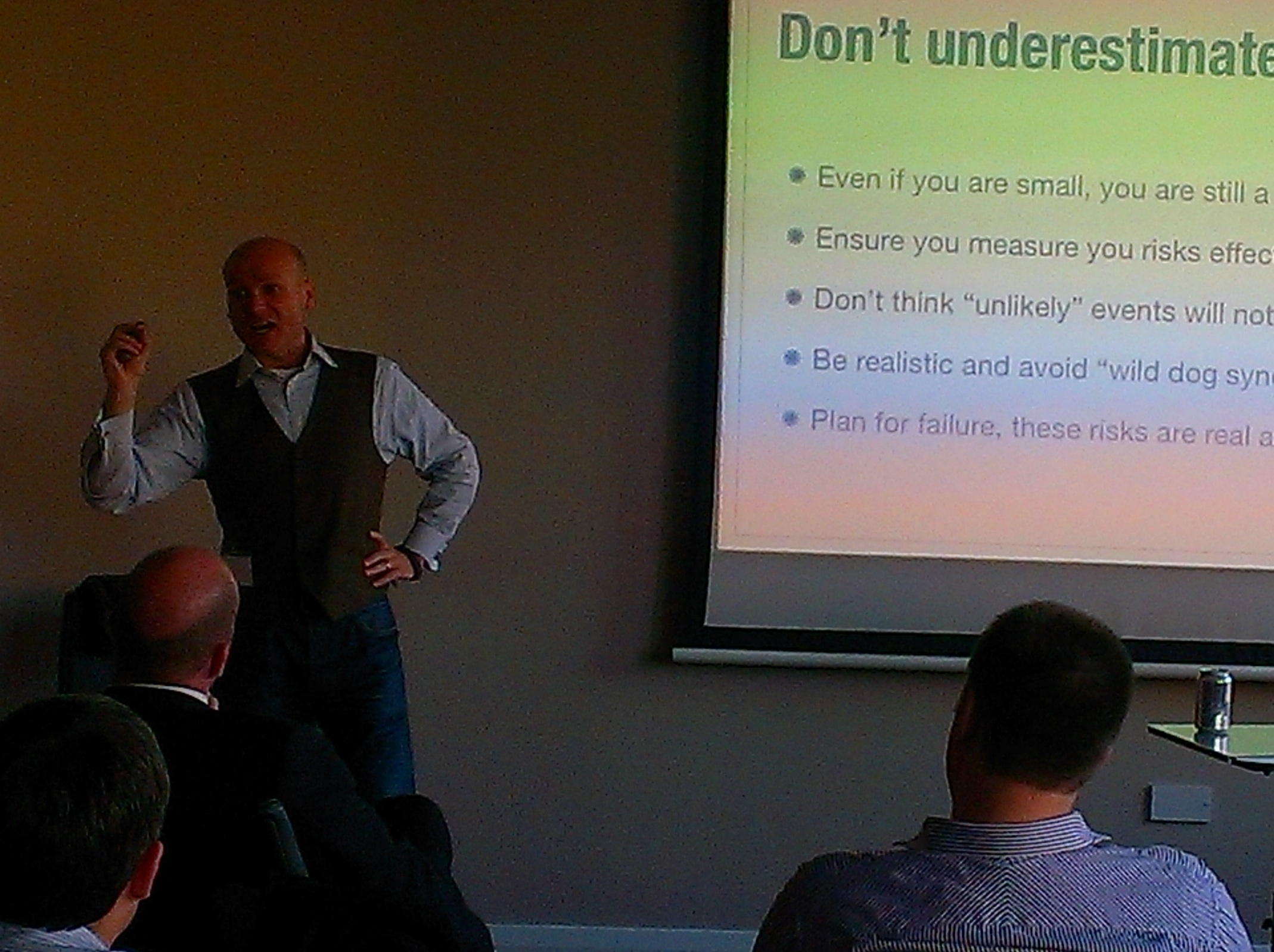
Finally it was my turn. To be honest I was somewhat apprehensive following these two presentations; there was a huge amount of interaction to this point and while my presentations somewhat relied on audience participation the main points I was raising were quite high level and in some cases not often talked about. I shouldn’t have worried. I had an absolute blast talking about different elements of risk management and getting some excellent feedback, comments, questions and of course different opinions. My case was obviously helped by the fact that I was handing out prizes for each correct answer identifying a quote to a film! The presentation itself is below along with a few snippets of the presentation itself taken from the back of the room.

I have always been impressed with the ISSA-UK meetings, the quality of the discussion between people and to be honest the great value that membership of this association brings. I am very much looking forward to more of these, and if asked to present again at one of their sessions. My thanks to Alan and Gabe (@infoseccrow) for giving me the opportunity to present here.

UFOs Dirty Dancing and Exploding Helicopters (PDF)


European Security Blogger Awards 2013 – a Thank You and an important tip

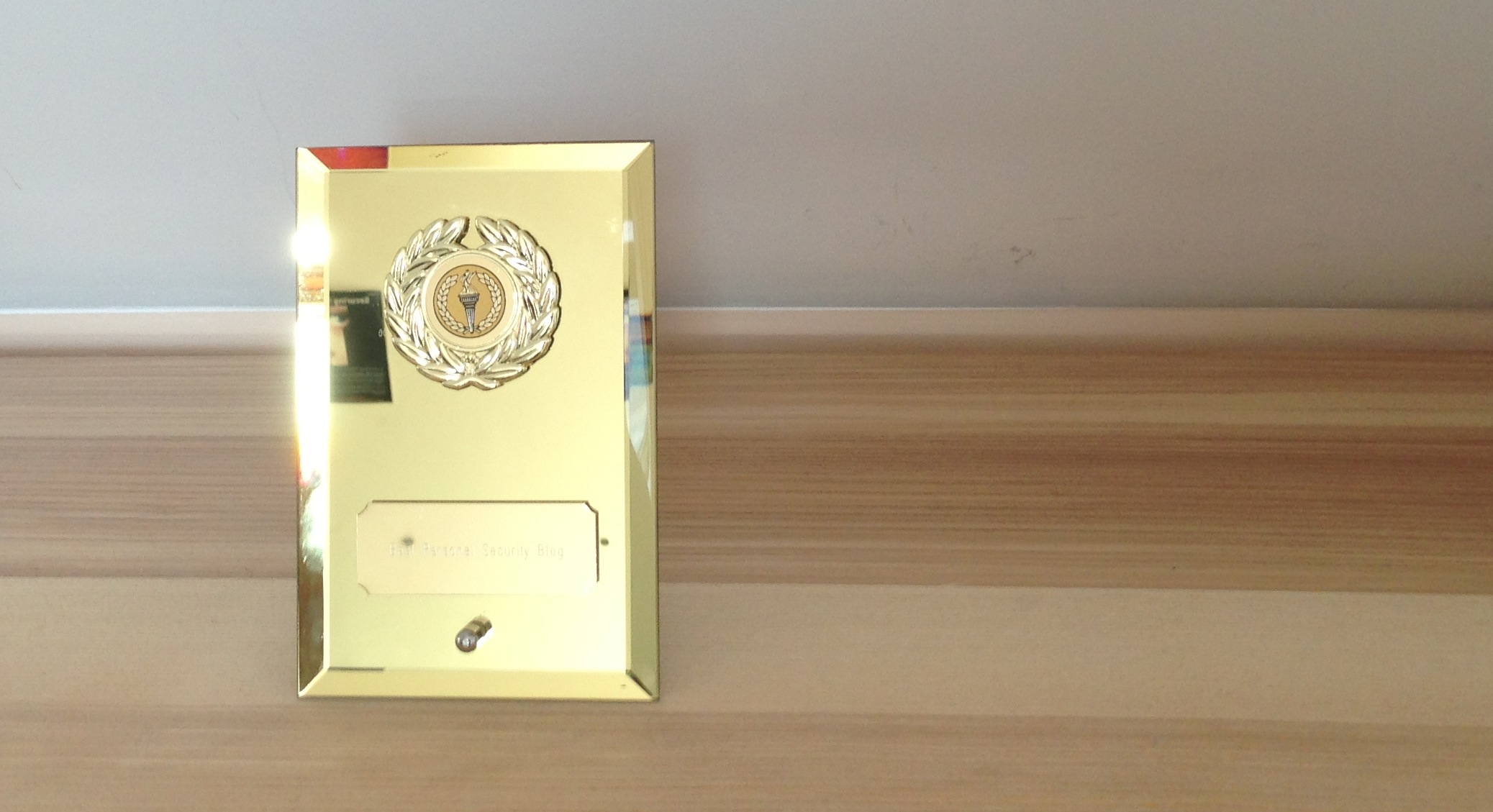
The Beautiful Trophy Itself

One of the Shiny, Beautiful Trophies

Just over a week ago the good, the awesome and the rockstars of the European blogging scene centred upon the the function room of the Prince of Teck pub in Earls Court for the inaugural European Security Blogger Awards of 2013. The atmosphere had a nervous tension and a strong feeling of anticipation (as well as a few bow ties for some other award going on immediately after that night!). These awards would not have happened if it wasn’t for two gentlemen in particular, namely Jack Daniel (@jack_daniel) and Brian Honan (@brianhonan) and without the sponsorship of Tenable (for the bar) and Qualys (for the trophies themselves). Both of them organised this off their own backs, were extremely gracious hosts and ultimately did this for the betterment of the European infosec community, and I wish to recognise that formally.

Thank you Jack and Brian, and to our sponsors.

But moving onto the awards themselves; after an initial round of blind nominations, the finalists were announced on Saturday 13th April and a no doubt frenzied bout of voting commenced, interspersed by all the finalists vying for your votes. My favourite had to be this one from Kai Roer (@kairoer), someone certainly not known for his modesty!

Kaibloggeraward

But aside from my evil twin shamelessly and quite rightly asking for votes (he has a great blog, check him out!) there were regular reminders and links from Brian and Jack to get voting and many retweets. I’m not sure how many votes were cast but I imagine they were well into the hundreds.

And so the night came, and after a day at Infosecurity Europe just over the road, and the practising of our “disappointed we didn’t win but SO happy for the winner” faces, it was down to Jack to announce the nominees and winner. They are listed below, but before that I want to move onto the tip I promised in the title…

Below are links to some of the smartest minds in our industry, and not only that, but they are willing to share their knowledge with you, for free. In any industry that is a rare gift to be given so I would like to encourage everyone who reads this to visit some of these blogs and follow them on Twitter, and also actively participate in the discussions, opinions and (dare I say it) thought leadership that is being presented. As a blogger myself I know the thrill of discussing a topic with someone, whether they agree with me or not. If you disagree with something that is being said, then politely and respectfully say so and put your point across. Even a simple message of support or a ‘Like’ means these people are going to be more likely to continue to blog and share their ideas with you in the future. And of course, if you think you can do better we would welcome you with open arms; this is not an exclusive club.

And so, without further ado, and a final thank you to Brian and Jack, here are the results of the European Security Blogger Awards 2013!

Best Corporate Security Blog
Malware Must Die
Sophos Naked Security Blog  < WINNER!
F-Secure Labs Blog
Countermeasures
SecurityWatch
SCRT Information Security
Cyberis Blog
Security for UK Legal Professionals
Holistic Security Blog
Securelist

Best Security Podcast
Finux Tech Weekly 
Eurotrash Security Podcast  < WINNER!

Best Security Video Blog
Christian008
Info Cynic < WINNER!
Security Tube

Best Personal Security Blog
Chat Back Security
Neira Jones
/Dev/Random
Pentest-n00b
The Roer Information Security Blog
SecurityWatch
Make IT compliant – Security and Compliance
Naked Security
Thom Langford  < WINNER!

Most Entertaining Blog
The Gentleman Hackers Club
Info Cynic  < WINNER!
Sophos Naked Security Blog
Holistic Security Blog

Most Educational Blog
Sophos Naked Security Blog
Infosec Cynic
HTML5 Security
Security Watch  < WINNER!
Securelist
Holistic Security Blog
Professor Alan Woodward Blog
Offensive Coder
Bruce Hallas 

Best New Security Blog
Jitender’s blog
Advent IM Security For Schools
Chatback Security
Marlin Brighton Blog
Dave Waterson on Security  < WINNER!

Best EU Security Tweeter
@rik_ferguson < WINNER!
@jameslyne
@_securitycat
@ChrisJohnRiley
@quentynblog
@j4vv4d
@brianhonan
@xme
@securityspeak
@gcluley
@n0x00
@0x6D6172696F
@mikko

Grand Prix Prize for the Best Overall Security Blog
Sophos Naked Security Blog < WINNER!
Infosec Cynic
F-Secure
Security Watch
Light Blue Touchpaper
Holistic Security Blog
Didier Steven’s Blog
Bruce Hallas 

If you made it this far you may have noticed I was very honoured and pleasantly surprised to have won Best Personal Security Blog, and against some real industry heavyweights too. My thanks to all of those that voted for me, it means the world to me.


We turned around, and there he was… gone!

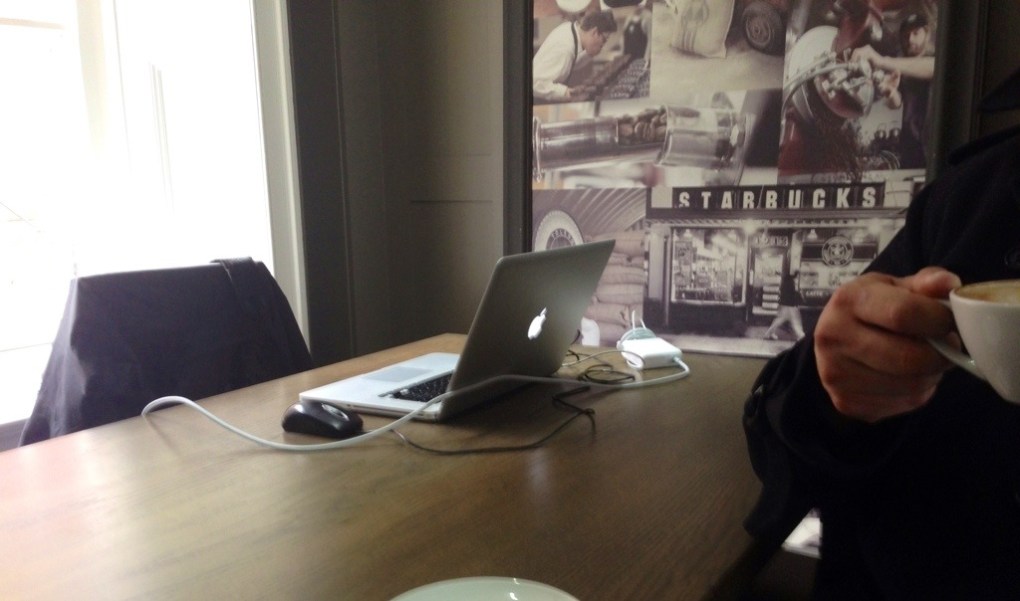
This is a picture taken in Starbucks, just a few minutes ago. Can you guess what’s missing?
Why the owner felt it was a good idea to go to the toilet (while carefully taking his iPhone with him, because otherwise it might get stolen!), leaving his laptop in a busy room where it could be easily removed is beyond me. It was made worse because when I peeked around the screen, it was also not screen locked.
With so much noise and argument going around the infosec community at the moment around security awareness the lazy conclusion would be that all users are idiots and need their hand holding all the time before they hurt themselves with their private data. Of course it is never that simple but it is no less infuriating to see this kind of attitude in practise. Where do we go from here in trying to avoid these situations?
I have a colleague who likes to highlight that we should consider our laptops and tablets and other various devices as “bathroom buddies”. I didn’t like this term at first (my knee-jerk reaction against the American use of the term bathroom), but it really does make sense. When in a public place such as a cafe, train etc and you need the toilet or a break, take your equipment with you! It is a simple alliterated phrase that sticks in the mind, makes you smile and therefore might actually make someone change their behaviour.
On the subject of humour, there was an XKCD cartoon very recently that summed this up perfectly.
The point is that this individual who left himself logged in could have had untold damage done to his personal and professional reputation if I was so inclined. Facebook posts, Tweets, work emails, Amazon orders etc could all potentially have caused him grief. Sure, after the fact he could probably “tidy up” the mess, but why put yourself in this position?
In the security awareness debates, system design is often touted as the way ahead, and in actual fact I think this may have come to the aid of our hapless coffee drinker, if he was lucky. The laptop itself looks like a new MacBook Pro, possible a Retina given the new style charger. That would mean he would be running Lion or Mountain Lion, which means FileVault is installed, although not enabled by default. If it was enabled and I ran out of the cafe with his laptop chances are when I sat down at the nearest park bench to check my prize the laptop would have locked and required a password. There is a good chance there that his data would be secure and encrypted. The same would be true if it was a Windows 7 or 8 laptop. The problem here though is that the key phrase above is “not enabled by default”. It’s great these operating systems now come with encryption built in, but there aren’t even annoying prompts a la Microsoft that, for instance, I don’t have an anti virus program installed; it is left entirely to the user to be educated and security savvy enough to enable it. I have joked on this blog before that encryption today is at the same level of anti virus of twenty years ago (Dr Solomon’s anyone?). Today, I would wager virtually everyone knows about anti-virus, and in fact it is often bundled and enabled by default on new laptops. (I am not going to take this opportunity to talk about the efficacy of anti virus as an endpoint protector!). When will encryption become such a commodity that you are an oddity if you don’t have it?
This isn’t a particularly racy topic, but it is one that is played out every day in cafes around the world. As every teacher will tell you, when you get the fundamentals right, the rest will follow far more easily. This person really should have known better, but when will we be at a point that he wouldn’t have had to?


From Paris With Love; the oncoming storm of the generational gap

frompariswithlove_1The media has been awash with stories about Paris Brown, the UK’s first youth police and crime commissioner who felt she had no option to resign even before formally taking up her post as a result of allegedly offensive messages she had posted on Twitter.

To many, she had done nothing wrong; here was a teenager who was simply testing and pushing the boundaries of her adolescent world, sharing views and comments in her private life in an attempt to learn, identify with and grow into an adult. She had been chosen from a large number of candidates for this role precisely because she was typical of many of her peers, and her views of the world and the society she lived in, warts and all, were almost a requirement of the role in the first place.

To others, she was demonstrating vulgar and offensive sensibilities in a public domain that have no place in a role in public office. To that end Kent Police are currently reviewing the tweets in question so ascertain if a case should be made against her.

I believe this is going to be the thin end of the wedge, and that many more instances of issues like this will come through over the coming  years. This is going to have, in my opinion, a number of ramifications in our industry in a number of areas:

BYOD. The adoption of smartphones across society combined with bring your own device policies across industries has meant that the boundaries between personal and professional life are becoming increasingly blurred. This blurring means that people will increasingly lose the definition between what can and can’t be shared from the workplace which is going to become an issue. Sharing confidential documents via a BYOD enabled smartphone to personal accounts so they can be worked from home is not going to be seen as an issue; the content is on “my” device after all. Tweeting or blogging about activities from the workplace is increasingly the norm, even if those activities are confidential or secret. Even the acronym NSFW, not safe for work, has evolved to identify what content may or not be suitable for viewing and sharing in the workplace (how else can I get the time to view all of this awesome content?). As quickly as NSFW has come about I predict it’s demise as these boundaries crumble and fall and anything and everything will be considered as acceptable to view at work as long as it is on “my device”.

Privacy vs Personal.  There has been a growing trend amongst recruiters to look at the social media profiles of potential candidates. There is nothing illegal or unethical in this per se, although even standard police employment checks for the kind of role Paris Brown was entering into don’t specifically call out the need for social media checks/reviews. This is the dichotomy of the situation; how can I expect privacy when I do not observe it with my company data, and yet posting my weekends antics to my friends should remain with my friends, and yet this is the very real expectation it seems. How long will it be before this crashing realisation for a generation of people that what they have done in their adolescent years as they grew up really wasn’t just between friends but between the whole world, and put them at a distinct disadvantage in the job market? And will this realisation bring a raft of legislation along the lines of age discrimination, that disallows the use of this information during interview? There have already been cases of prospective employers in the US asking for Facebook credentials of candidates in order to check their backgrounds. Whilst this does cross moral, ethical and professional lines in many of our books, this is the inevitable alternative if this legislation doesn’t come in. As an infosec industry we will be on the front line of educating people of these consequences and potentially enforcing any incoming legislation in the workplace.

Professionalism in our Industry. But what about the here and now? As a profession we are held to a high standard of professional standards and ethics. All the organisations that we affiliate ourselves with to one extent or another have clear professional ethics. If during the recruitment process you have an opportunity to review somebodies social media background, would you take it? How would you use that information, and to what extent would a checkered social life influence your decisions? There are two sides to this of course; do your professional ethics stop you from looking (or just taking action from them), but then again would you want someone who appears to display a lack of self control and publicly put themselves into position of vulnerability that may allow them to be more easily bribed or blackmailed in an area that demands high levels of security and trust?

This generational gap in appreciation of the long lasting impacts of current social media in the world of big data is an area I believe is yet to be addressed fully. The sociological impacts of a series of younger generations engaging with an always on culture of social media are not yet fully understood and should be explored further. I hope the above is dipping a toe in the water of this huge body of water. Ultimately, if you are not paying for it, you are not the customer; you are the product…

h330E1FA4


RANT Panel Debate: “Should You Train Your Users on Security Awareness?”

I spent last night with five eloquent, passionate and above all opinionated colleagues arguing the pros and cons of security awareness training. We were doing this at the monthly Acumin RANT forum to a packed crowd who, as always, were not shy in holding back on their opinions.

The Crowd, who make RANT what it is!

The Crowd, who make RANT what it is!

We had two stand ins replacing Christian Toon and Kai Roer in the form of Bernadette Palmer and Andrew Agnes both of whom bought a huge amount of experience, opinion and humour to the evening. The lineup therefore was:

 For:

(The Award Winning) Javvad Malik, @j4vv4d

Bernadette Palmer

Andrew Agnes @sirjester

Against:

Myself

Geordie Stewart

Rowenna Fielding @infosecgeeklady

We did a standard pre vote just before starting (we garnered no votes and a lot of good natured laughs as expected!) and then we went straight into the standard For and Against cycle with me kicking off. Nobody had briefed me (or perhaps I hadn’t listened…) that we were reducing our standard six minutes each down to three! A quick reshuffle in my head and we were off. The photos may look like I am singing Karaoke, but beneath the entertaining exterior was my serious message!

I have posted my core arguments to this blog before so I won’t rehash them here again but what followed over the next eighty minutes was hugely interactive, passionate, thought provoking and hilarious! With a few dongle and fork gags thrown in this debate had everything! Of course there was no real conclusion but at the closing vote there was a small but very definite swing in our favour, hooray!

The Karaoke King!

The Karaoke King!

What I found the most interesting however was that on the whole our arguments converged; we all acknowledged that information security training as it stands now is simply not working. What we do with it however, was where the real debate lay. Do you throw the whole lot out and start form scratch or do you continue to try and fix what we have? I think this is the dilemma we need to face up to sooner rather than later in the industry, once of course we accept that our training programs don’t work. That part is where the industry needs the most help.

I normally try and stay around after these kinds of events and listen to other peoples opinions, gather feedback and generally mingle. Tonight however I had dinner with a few folks (@jimshout, @j4vv4d, @sirjester, @jee2uu) to discuss an upcoming project. More on that in the next few months but it was a productive and exciting evening overall.

Finally, there was some footage taken of the evening by Gemma of Acumin; like all my footage if it ever sees the light of day I will get it posted here as soon as possible! As always a huge thank you to Gemma, Simon, Chris et al from Acumin for not only making this happen but asking me to be a part of it.

Andrew Agnes

Andrew Agnes

Geordie Stewart

Geordie Stewart