Less is sometimes more; InfoSec’s role in the business

Funny-and-Lazy-Animals-7-300x229I read an excellent article the other day from a LinkedIn reference talking about how laziness can be an effective approach to productivity. It dispelled the myth that “leaning in” when applying yourself to your job isn’t always required to do a good job. There is no need to get up at 04:30hrs to get your morning yoga done before getting to the office at 06:00 and working through the next fourteen hours. it even makes mention of an old Prussian army management matrix that made use of this concept. It reminds me of a Bill Gate’s quote (although it sounds like Steve Jobs!):

I will always choose a lazy person to do a difficult job, because a lazy person will find an easy way to do it

When put like that it sounds right, and yet the concept of using a lazy person seems counterintuitive. Perhaps we should replace lazy with “busy”, or “time poor”, but I think the point is well made nonetheless.

It reminded me of when I wast first put in charge of an information security project to ascertain the organizations level of exposure to personally Identifiable Information (PII). There had been a number of high profile breaches in the media, and the leadership was concerned about how many records we had access to and what we were doing about it. My approach was to work with a very talented team of junior infosec professionals, and we came up with an amazing spreadsheet that tracked every facet of what we thought we might need with, with macros and reporting buttons, lovely color scheme etc. We even tried to make it as friendly as possible as the trick up our sleeve was that we would be asking 95% of the organisation to fill this in themselves (and therefore saving on high labour costs to get this done). The other 5% were the very risky ones we already knew, so they got a personal visit from us to make them feel really special!

After a month of pushing, chasing and cajoling, our completion rate was something like 13%, and we were just a few days away from our deadline. Senior management were not happy, and demanded a full review. The career dissipation light started blinking in my peripheral vision.

We were trying to be far too clever for our own good, far too detailed, we wanted to cross EVERY i and dot EVERY t, whatever the cost to the project and the business. We were detail oriented and were going to get the most accurate report this company had ever seen. Except we didn’t. I was clearly told in no uncertain terms that I had completely misunderstood the business, how busy they were, how finite detail wasn’t what was at stake but getting a good idea of the scale of the problem was, and also to understand that people are generally doing their best to protect the company and were not in the habit of hiding the sort of activities we were doing our best to uncover.

We reduced the 154 question spreadsheet to 10 questions, some of which were voluntary. They were the the most important questions we had to ask, and we subsequently got the data we needed in a little over three weeks for roughly 97% of the organisation (you can’t help some people unfortunately). I managed to keep my job.

Perhaps it is our backgrounds in audit and compliance, but we infosec professionals love our checklists, our questions, our matrices and black and white answers to really drill down to the finite detail. That is not to say that at times they are not important – a good penetration test does need to be detailed and very complete, but that is mainly because the expectation of it being so. It wouldn’t surprise me though if 20% of a pen test uncovers 80% of the vulnerabilities. Vendor security questionnaires, risk assessments, audits, project or team reviews etc., can all potentially be done just as effectively with an element of brevity. Understanding what is important to the business and not to the security function is key here. If infinitesimal detail is important to the business then by all means go for, just ensure that is what the business really is after. most of the time they just need a reasonable picture.

Creating barriers to the successful adoption of security practices by using fifty page reference documents, or encouraging people to work around a security risk because doing the right thing involves sign off from six different gatekeepers is not a recipe for success as it puts the organization in direct opposition to the security function. By making sure that checklists and questionnaires are focussed, relevant and to the point will only encourage people to adopt the security measure that matter because there is clear benefit for a small amount of input.

We have all got better things to do with our time than collate thousands of questions that we have insisted are answered in order to ensure that the ultimate security objectives have been met. In some instances there may be value in that, but in the majority of cases I would wager there is none.

And besides, the rugby/cricket/baseball* match is on this afternoon, so we need to leave early to catch the game.

*Delete as appropriate. Just don’t add football.


Why do we put brakes on cars? Perhaps not for the reason you think.

Bosch Predictive Emergency Braking System

I have never liked the analogy;

Why do we put brakes on cars? So we can go faster. Therefore we put security controls in place so we can do riskier things.

I mean, I get it, the analogy makes sense, but like many analogies, if we are not careful they are likely to become a little too one dimensional. We also have brakes on cars to slow down for traffic lights, to ensure we don’t go too fast and run into the back of  the car in front, and also to stop the car quickly to avoid someone crashing into us. I am sure with a squeeze and a shove we could fit these analogies into an infosec analogy, but why bother?

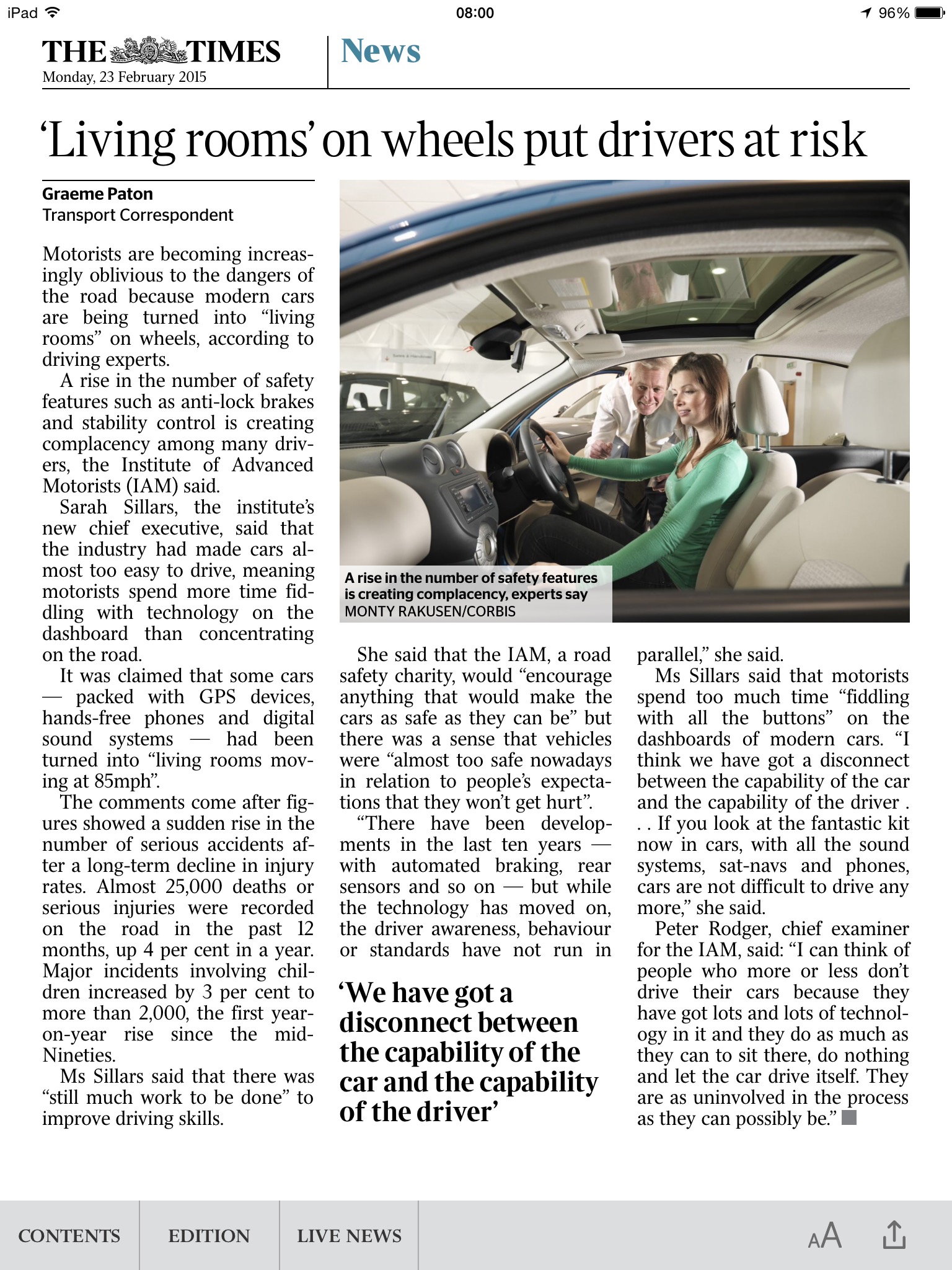
I was reminded of this particular analogy and why I don’t like it this morning as I read my paper. The headline really resonated with me;

‘Living rooms’ on wheels put drivers at risk

The Times, Monday 23rd February 2015

The Times, Monday 23rd February 2015

The article discusses how the increase in technology in cars has actually led to an increase accidents in recent years. The anti-lock brakes, stability control etc. is creating complacency amongst users, and putting them and others at risk.

If we are not careful we are shifting towards this in our industry. It is of course a good thing to focus on secure coding practises, OWASP, secure by design etc., because that is as important as a seat belt and an air bag in a car (oops, see how easy it is?!), but if we try and put everything into those particular controls, we are abdicating responsibility away from the user more and more. By creating an insulated and isolated environment in which they operate there is no positive/negative feedback loop, no opportunity to learn from mistakes, near misses or even dumb good luck. They quite literally are on their own being guided only by what their immediate vicinity is reporting to them. Another quote;

They are as uninvolved in the process as they can possibly be

This could be describing our users and clients who we are removing more and more responsibility from when it comes to making sensible, thought out decisions about basic security. We are removing their perceived responsibilities as they say to themselves “if the system is letting me do this, it must be alright” as they download malware specifically designed to undermine so called built in security. (Actually the quote is from Peter Rodger, chief examiner for the institute of Advanced Motorists commenting on cars being turned into living rooms.)

Let us continue to understand how mature our security development framework is, let’s observe the OWASP top ten, but let’s also continue to establish clear guidelines, education and expectations of our people at the same time. If we don’t, we may be congratulating ourselves little too early for running a good security programme.

If we do that, we risk going back over a century in time, and putting the cart before the horse, let alone putting better brakes on the car.

(If you want good analogies however, that can help your people truly understand the information security environment they are operating in, head over to the The Analogies Project.)

Securi-Tay IV

TransparentLogo1-e1423236103647I will be spending the end of week with the Abertay University Ethical Hackers at their Annual Securi-Tay conference in Dundee. It’s a great conference so if you are at a loose end for Friday and in the area make sure you rock up and say hello to the lovely folks up there!


Are you one of “them”? Damaging your information security efforts without even knowing it

90ee2b65615c3fda2b2c4190697c34d4It was ten to six in the morning, and I was on the  station platform waiting for my train to arrive to take me to London. As I walked past two people who were talking, one of them was earnestly telling the other about problems in his office that were caused by “them”:

they’ve changed the heating in the office to make it more consistent apparently but what they don’t realise is that it is sending us all to sleep. They just don’t get it, they’re idiots, and it’s a waste of money

It seems the faceless bureaucrats and management just don’t get it at this gentleman’s place of work and are doing everything they can to hinder the company’s ability to work effectively! But scratch a bit deeper and you may see a slightly different story of trying to deal with complaints from parts of the building that are too cold, using antiquated heating systems that don’t balance heat well the further from the heat source they are, or even just trying to make everyone feel more comfortable in the cold winter months.

The unfortunate impact of their actions though is that productivity has dropped in some areas, and the impression of the team and people behind it has dramatically reduced.

I have regularly stressed the importance of information security ultimately contributing to the success of the business, allowing it to sell more beer if you will, but that is only possible if you understand the business, collaborate with the people on the ground, and align your efforts to their goals. By treating risks in isolated parts of the business without looking at the wider impacts you run the risk of overheating other parts of the business. What initial makes sense in one place does not make sense in another, and the quick win you thought you had really turns out to require a far more nuanced approach.

If what you are doing is simply unavoidable and impacts to the other parts of the business will be felt, then collaboration and communication is vital. Explaining the complaints, challenges, risks etc. and allowing them to voice their feedback is important to ensure people remain bought into your plans. Who knows, you may actually get some better ideas from them that you hadn’t even considered. This approach requires nerves of steel and the skin of a rhino though, as many will see the opportunity to take a swipe at you, but seeing the process through is far more effective in the long term.

Asking for feedback afterwards, chatting to individuals and leadership about what they think about what you have done, and putting that feedback to work to improve your next iteration of the programme all help bring people on side and improve the effectiveness of your information security stance.

Once you are seen to be working in the long term interests of the company and the people who work there, decisions you take and implement will be seen in that wider context, and not just as the actions of someone just “doing their job” and being one of… them.


Flushing Risk at 44CON

logo-1I have just returned from two long days and two long nights of 44CON, the premier conference in London for technical InfoSec professionals (and even a few of us management types). It saw the debut of by “Flushing Away Preconceptions of Risk” presentation, an expansion of the my recent post for the Analogies Project.

The core messages of the presentation are not necessarily pleasant ones; the correct use of risk in any organisation is one of the most powerful tools in an information security programme, and yet it seems to me that very few of us understand it fully. Many of us struggle with not only identifying what the real risks are in the first place, but also how to measure them and even how to properly treat them.

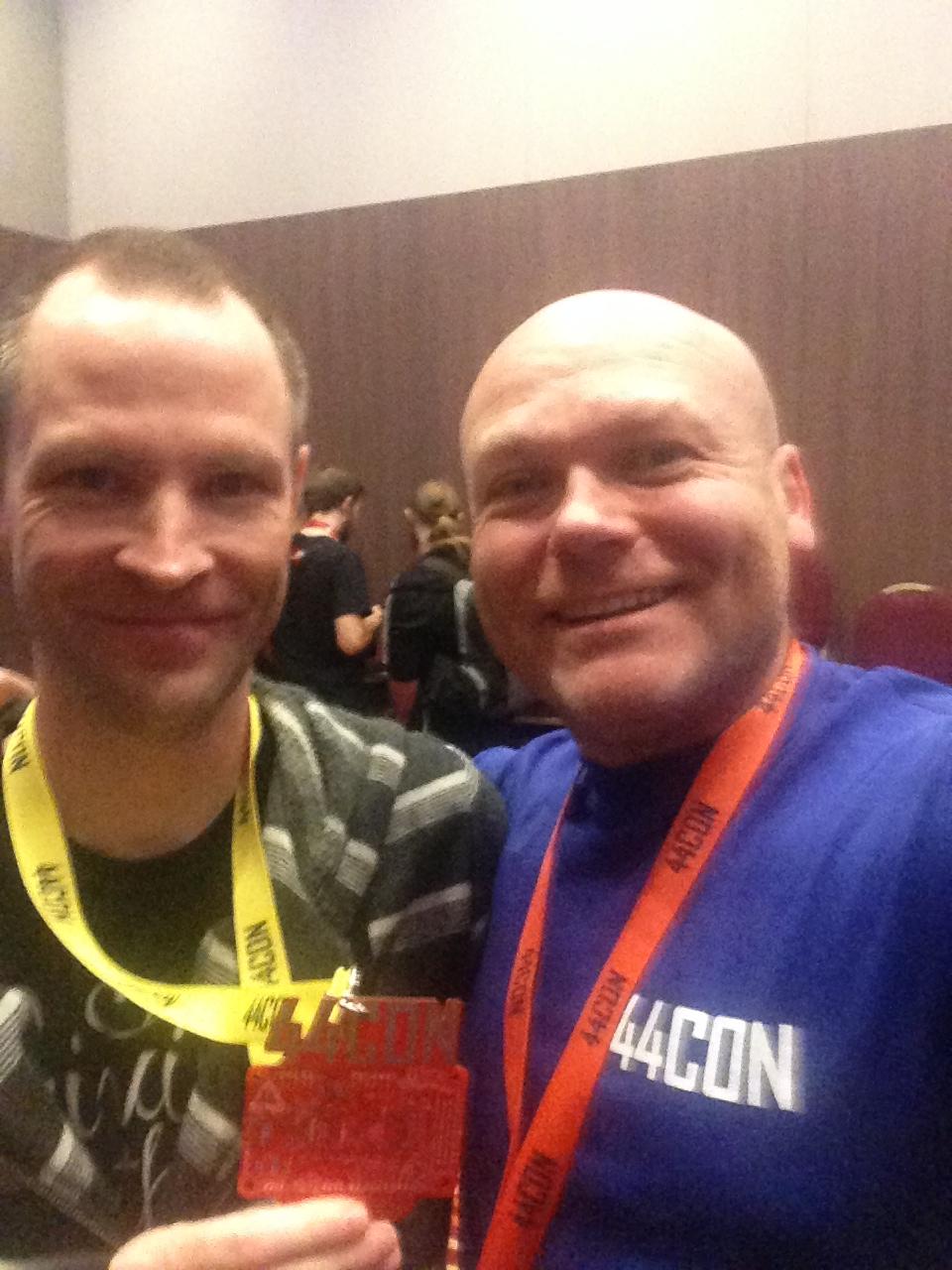
Doing my bit to advertise 44CON

Doing my bit to advertise 44CON

Identifying risks at first seems like an easy think – identify assets, and then identify what could go wrong. I won’t elaborate the analogy much here (read it at the Analogies Project), but given how we regularly fail to identify risky behaviours correctly in our daily lives it should be no surprise we fail to do so professionally. The same bias applies to when we subsequently try and measure the risks; every mechanism we use introduces potential errors and even vagueness. I was quite proud to introduce the Langford/Malik Risk Model (ver 1.0), an approach that I evolved from one that Javvad Malik introduced in his book. Again, it uses an analogy although this time of a pub fight to not only describe levels of risk but also risk appetite. I do hope that not too many of you will find it useful next Friday and Saturday night.

ThomLangford_2014-Sep-08

The Langford/Malik Risk Model ver 1.0

Finally the effective treatment of risk was covered, and how we so often simply do what has been done before, not what is going to be effective now. Just because a risk hasn’t been realised doesn’t mean you have treated it effectively, it just means that an incident hasn’t happened (that you know of).

The slides are below, but since my presentation style has evolved more into storytelling rather than bullet point reading, by themselves they may say little to you, but the session was recorded and when it is released I will make it available here. Like any presentation it barely touches the surface of risk management and its issues, but it was intended to be thought provoking and prompt people to not assume that just because they have always done things in a certain way that it is the best or even correct way.

This slideshow requires JavaScript.

As for 44CON itself, well, any conference that has a “gin o’clock” on each day has to be pretty good in my books! It was a very well organised conference, with an excellent and highly motivated Crew to help support it. SpeakerOps were particularly good providing a personal touch I have not seen at any other conference. The quality of the talks and the speakers was also excellent, but as I alluded to in my introduction, many of them were technically beyond me!

The highlight for me however was a workshop I attended demonstrating the beta version of the Cyber CPR product. This is a virtual machine (that can also be deployed on ultra portable hardware if need be) that builds and entire incident management environment allowing for the discovery, gathering and analysis of evidence during an incident. It build a virtual “war room” environment, where multiple incidents can be tracked at once, in a secure and separate environment from the one that has actually just been breached. With tools built into the backend and access via a browser it even does away to have many of the tools on your own environment, making it great for remote and ad hoc use alike.

The product is in Beta at the moment, and does lack a few features, (they described it as not ready for active duty), but what i saw  was very polished and useful even in it’s beta configuration. Commercially it will be available for free with up to three users, and only $5k GBP for up to twenty (please don’t quote me on these figures though). I would strongly recommend you take a look at this excellent environment that for very little outlay will significantly improve many current incident response teams, and their over use of Excel. The team expects it to be commercially ready by Spring next year.

ThomLangford_2014-Sep-13

Obligatory selfie with Jonathon Schiefer

The final highlight was to be able to meet Jonathon Schiefer  the director of the film Algorithm  which had its European debut at 44CON on Wednesday night. It was fascinating to hear about the backstory of the film, his challenges and even how he made the film financially and technically. He was an absolute pleasure to chat with, and I thoroughly regretted my decision to have a curry instead of watching the film. At a stretch you could say we are kindred spirits when it comes to our film making, but he is without a doubt in an entirely different league to me!

44CON will be back next year, but we were also enticed with the news of another 44CON spring conference being planned as well. I would strongly recommend anyone who can get to London to attend both of these conferences. Congratulations to Adrian and Steve and the many people in the crew for putting on a fabulous conference.


What My Tailor Taught Me About Value

0130bespoke01_G_20110131021109Do you really understand the value of the data in your organisation? Some of it is fairly straightforwards, such as personally identifiable information (PII) and/or credit card information ($188 USD per record in direct and indirect costs to the organisation for every record lost was the figure I last heard and used).

What about your intellectual property though? Or client RFP’s and and pre-sales work left on the train? Salary information? Internal network architecture diagrams? Sometimes, when this information is lost it is difficult to ascertain its value,  impact to you and your organisation and therefore the scale of your response.

I was reminded of this value quandary while I was having a second fitting on a suit I was having made at the shop of Charlie Allen in Islington. Before anyone makes a judgement on my salary, the suit was a very welcome prize from my time at the InfoSecurity show in April, from the good folks at Sestus. I have had suits made before, normally in India, but this was my first suit to be made wholly in England and knew there would be a difference in price if i were to pay for it myself. After the fitting I asked to be measured up for some new shirts; I thought I would treat myself and take advantage of the time in Charlie’s studio. I checked the price of £200 with a minimum order of three. Good value I thought, three shirts for £200. It was only after the fabric selection, design, measurements etc the invoice came… The shirts were £200 each, a total of £600. I very nearly handed over my credit card simply to avoid the humiliation of admitting my mistake and exposing myself as someone who quite obviously shops in Top Man.

Blustering my apologies, I mentioned something about obviously not understanding the true value of these shirts, asked for the quote to be put on file for “later” (i.e. when I win the lottery) and made a quick exit. However, as I walked back to the office I realised that it was obviously going to be £200 each; a good quality short from Thomas Pink off the peg costs between £80 and £100 each, therefore how can three made to measure shirts cost £200? I had woefully underestimated the value of something that was actually quite obvious in hindsight.

So what? Understanding your information assets, and their value is a table stakes exercise. Doing this will allow you to do two things;

  1. Understand the total value of your assets and use the figure to work out what kind of exposure your organisation is likely to experience in case of a breach.
  2. Subsequently use this information to build a realistic business case for protective and preventative measures to avoid that breach in the first place.
  3. Ensure the scale of your response when those assets are compromised is commensurate to their value.

There are plenty of good resources to help guide you on this, but one of the most important pieces of the puzzle is to understand the financial value of your assets in the first place, and certainly not after a breach.