An Approach to Risk Decision Making – a Review

Public expenditure

I decided to write a review of a paper submitted to wired.com on the subject of “An Approach to Risk Decision Making” by Curt Dalton. I must however declare an interest in this, in that I happen to report to Curt in my day job (he is global CISO), and that he was kind enough to share drafts with me as he wrote it for feedback. This will of course therefore be a somewhat biased review, although not too much, but I do hope if nothing else it generates conversation around topics and approaches like this. I have a huge respect for Curt, have learnt much from him over the last few years and hope to get a good score in the next performance review!

In essence, this model is designed to help an orgnaisation decide if it is financially viable to invest in security technology/controls/procedures in order to address a given risk. It is not designed to be used across an organisations risk management porogramme, but rather with those handful of risks that can’t be addressed in day to day operations and have to be escalated to senior management to be effectively resolved.  With limited budget and access to that senior leadership, this approach provides support and guidance on what to ‘fix’ and what not to fix.

This scope is a key element of the model; it uses very traditional approaches to monetizing risk versus the more in vogue approach I have reviewed elsewhere in this blog. To that end it uses assigned numerical values to elements of its calculations; this is of course where ‘errors’ may creep in, but in theory an experienced risk manager familiar with their environment should be able to assess this reasonably well.

In summary, the model is as follows:

Figure1_660

Figure 2 in the model requires an analysis of controls required to address a risk.

Figure2_660

This does of course beg the question, how do you know you have all of the controls required and how do you know you have selected the correct numerical value? Again, the pragmatist in me suggests this is entirely possible with someone who is familiar with the environment and the organisation, but this may of course be more difficult in other situations.

Figure 3 does a similar thing with a similar level of granularity, i.e. defining in nine increments the ease of exploitation of a given risk; where I think there is potentially something missing is that this value applies to ALL of the risks listed in figure 2 rather than individually.
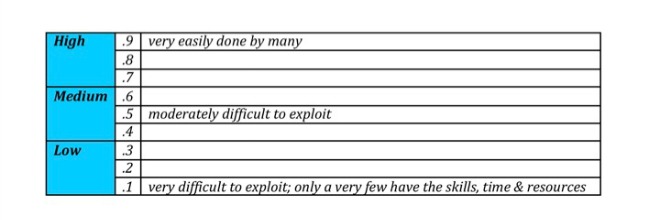
Figure3_660

Obviously this would massively increase the complexity of the solution but this is a deliberate approach to ensure simplicity across the model.

These two numbers are then combined with a simple calculation of impact to etsablish a level of monetized risk. Finally, the 80/20 rule (or Pareto’s Principal) is used as a rule of thunmb to define the actual budget that should be spent to mitigate a risk. In the example given therefore a monetized risk of roughly $1.5m USD should be mitigated by spending up to $380k USD and no more. The Pareto Principal can of course be adjusted accoring to your organisations risk appetite, that is, the more risk averse the organisation the more the rule would move from 80/20 to 70/30 or 60/40 etc..

There are a lot of assumptions used in this model, not least the numerical values that may seem to be arbitrarily assigned. However, I believe this can be forgiven for the very simple reason that this is a pragmatic, transparent and easily understood approach; it can be easily transferred into an Excel spreadsheet meaning that some simple modelling can be carried out. I have said before that until the newer approach to risk management has a more easily understood and implentable approach it will not be adopted. This model does.

The other part to this model that I like is that it is not designed to be a cure all, but rather a tool to help organisations decide where to spend money. If the approach is understood then an informed decision can be made within the constraints of that model (or indeed any other model). I believe it is influenced by the ISO27005 approach to risk management which means many risk management folks will be able to grasp and adopt it more easily.

Overall, this is a model that can be adopted quickly and easily by many organisations, and implemented successfully, as long as its basis in assigning numerical values is understood, and calculations are carried out by those in a position to understand their risk profile well. I would strongly recommend you tai a look at the model yourself over at Wired Innovation Insights.

Pros – easily understand, pragmatic, focussed on one business issue, easily implemented.

Cons – relies on assigning ‘arbitrary’ numerical values, doesn’t address granularity of risk and ease of exploiutation.


A late start back to 2014

YEAR+IN+REVIEW1This time last year I posted a WordPress summary of my blog and stated I was going to focus on “growth” for 2013. Fortunately WordPress sent the same summary as last year and so I am very pleased to say that I have achieved that, certainly in regards to posts, content and followers.

It was a hugely busy year as regards me and this growth, with just some of the highlights including;

* Establishing Host Unknown alongside Andrew Agnes and Javvad Malik, and making a start in showing that security education really doesn’t have to be dull.
* The opportunity to be a mentor to Gavin Holt for the Rookie track at BSides. Gavin is an extremely talented and intelligent InfoSec professional and I was thrilled to have been able to help him present.
* The inaugral RANT conference and being able to play a part in the day for the lovely people at Acumin.
* Presenting at RSA Europe again.
* Getting involved with The Analogies Project, curated by the very talented Bruce Hallas,  in addition to being asked to be a regular contributor to the Iron Mountain Information Advantage blog.
* Winning Best Personal Security Blog at the inaugral European Security Bloggers Awards.

Combine the above (just the tip of the iceberg) with a dramatic increase in followers of the blog and of Twitter and an increase in the number of requests to present I am extremely pleased with 2013.

The word for 2014 therefore is “maintain”. Much as I would like to grow last years levels of activity it did cut into my day job quite considerably so I need to be a little more selective in my activities. That said, I have already presented at Securi-Tay3 in Dundee and have another one for the 451 Group in a few weeks. I will post something about Securi-Tay3 in a few days time when the videos have been published.

There are so many people to thank for the success of 2013, some of whom are mentioned above, but there are many others out there to whom I thank; I have very much been fortunate enough to stand on the shoulders of giants, allowing me to grow as a professional in the infosec field.

(View the full WordPress blog report here)

Moving forwards I have plenty of thoughts for content for this blog over the coming months so stay tuned for more details, and thank you for following me in 2013!


Sailing the High Seas at 44CON

logo-1I have just returned from 44CON, a technical infosec conference that is held in London and in its third year. As with any multi day conference you come back tired but educated, and happy but deflated that it is over. A speaker party, a conference after party, two gin’o clocks, a conference bar and some fabulous presentations makes for an exhausting two days.

Organisationally it is extremely well run; the crew are are friendly, knowledgable AND efficient (it’s rare to have all three), the venue is of a high quality, the sponsors are low key but available, SpeakerOps is excellent, and with the exception of myself and two others the attendees are amazingly smart and technical. I was able to chat to a number of the speakers at a reception on Wednesday night, and the level of detail they went into for their research was simply mind-blowing; one person even decided to write his own 3D presentation language instead of using PowerPoint or Keynote, just for this one presentation!

I spent the first day mostly at the InfoSec track rather than the technical track, learning about “Security lessons from dictators in history” and “Surviving the 0-day – reducing the window of exposure”, both very good. I did attend a technical talk in the afternoon along with two friends (the two mentioned above!), and to be honest he could have been speaking a different language with what he was talking about; to make it worse he apologised at the end for not making it technical enough! It was a fabulous talk though, wonderfully presented, and let down only by my lack of technical knowledge of the subject.

As a backup speaker for the infosec track I thought I was off the hook at this point as nobody had dropped out, but it was announced at this point that there would be a “hidden track” of talks, of which I was one of them. This hidden track would take place at an undisclosed location and you had to talk to vendors and other con goers to find out where it was. It was at this point I excused from the after party to add a little more content to my slides.

Sailing the Cs of Disaster Planning 44Con.001

Sailing the High C’s of Disaster Planning – Click for PDF

The following morning, after the opening presentation I was second in the hidden track. My talk was entitled “Sailing the C’s of Disaster Planning”, and the main drive of it was of a simple “framework” that allows you to be be able to not only test the effectiveness of your disaster/business continuity planning, but also help to communicate the key elements of the plan upwards to the board and down through the key players in the organisation. This was the first time I had given this talk, and to be honest some of the ideas have not quite been fleshed out, although the concept is sound. It was well received by about 20 people (not bad given it was a hidden track) and there were some good questions and conversations afterwards. Feedback received later in the day was both encouraging but also useful in highlighting areas that need to be improved.

A copy of the slides are above; if you take a look at them please provide feedback as always (caution, 12.5Mb PDF).

I will be using this blog to flesh out those ideas and gather feedback over the next couple of months, firstly by looking at the high level concepts of this approach, and then subsequently break down the five elements of the approach into further blog posts.

The remainder of the second day at 44CON was taken up with more talks, as well as a bit of filming with my two colleagues, the two unknown hosts you could say, for something we hope to release in the next few weeks.

I would like to thank Steve and Adrian and the entire crew of 44CON for an excellent event, and I am certainly coming back for next year, at a new, larger yet undisclosed location.


Why I am an Analogies Project contributor

Bruce_Hallas-300x286That devilishly handsome bloke you see to the right is Bruce Hallas. I used to go to school with him nearly 25 years ago, and then last summer, at the first old boys school reunion that our year organised since leaving I met him again, and it turns out we are in the same infosec business. I spoke to him about all of the good work I am doing, the company I work for, the many countries I visited and generally tried to make myself feel more important than the skinny eighteen year old I was when I last saw him. He told me that he runs his own infosec consultancy, his own blog, works with the UK government, and was in the process of setting up “a project” as a freely available, self funding, resource of analogies/stories to help people better understand information security. (Bruce immediately won the “my life is awesome since leaving school” competition of course.)

Since that time, The Analogies Project has grown from one man, an idea and a website to something producing real, quality content, and with a very promising and bright future.

In the words of the Project itself;

The Analogies Project has a clear mission. To tackle the unintelligibility of information security head on and secure the engagement of a much broader audience. Its aim is to bridge the chasm between the users, stakeholders and beneficiaries of information security and those responsible for delivering it.

Through a series of innovative initiatives the Analogies Project will enable information security professionals to effectively communicate with their chosen audiences. The content will be delivered through a variety of alternative communication techniques, media and partners.

The part of this project that I like the most is that it is essentially a community project. Bruce isn’t charging money for membership to the analogies as they are written (and they are coming thick and fast now!), and none of the contributors are charging for their work either. There are not only the web contributions in the form of a library, but a book planned, a conference, and even an opera! With the momentum that is currently behind the project at the moment there is every reason to believe in its future success.

So why am I contributing? Honestly, I have selfish and philanthropic reasons to do so. Obviously it gets my name out there, allows me to practise my writing, test some ideas and also say “I was there from the start”. All that aside though, I have frequently struggled in my day job to get infosec concepts across to people, either directly, in meetings or even in awareness training. To have had a resource like this available to me five years ago would have made my life so much easier, allowed me to advance the infosec “cause” more effectively and given me a set of tools I knew were consistant with the prevailing thoughts of industry commentators. Having a centralised, peer validated, toolkit available is fundamental to us as professionals when it comes to the messaging we give to our users, clients, bosses, teams and even the infosec community as a whole.

It’s still early days, but I have submitted my first contribution just last week (soon to be published I hope) and I am already inspired enough to be working on my second and third. There are a number of analogies already in place, and I would urge you to read them and consider them in the context of your current communications to your audiences, whomever they may be.  The book will be another important milestone and one I hope to play a part in; indeed I hope to be able to play a part in the the project for the forseeable future, and why I am happy and proud to display my “contributor” badge up on the top right of this site.

TAP-Contributor-Semi-Transparent-250x160

If you feel you have something to contribute, then head over to The Analogies Project and let Bruce and the organisers know. If you don’t feel ready to, then certainly check it out anyway. You won’t regret it.


And they say security awareness training is working?

Having been involved in the security awareness debate quite a lot recently I have no desire to bang this drum even further, especially as on the whole I support the concept of security awareness training. However I am constantly having my faith in the training rocked just from observing people’s day to day activities.

I found myself in one of the lounges in Delhi airport at around midnight last night. in a period of less than thirty minutes I found two laptops and an iPad logged in and unattended in plain view. Now, I really do understand that people may consider these kind of environments as ‘safe’ and will therefore let their guard down. What I fear however is that they have blatantly disregarded their security awareness training and policies that will no doubt explicitly state that it is unacceptable to leave mobile devices unattended and unsecured in any environment, possibly including the workplace. Without wishing to become an amateur sociologist I would imagine these are educated, intelligent people because

  1. They are able to afford expensive looking laptops or have been issued an expensive looking laptop
  2. Are flying business class (or similar) and are therefore likely to be working for a company that can afford to pay for this level of comfort (a decreasing number on my experience)

If they are so intelligent and educated, why are they ignoring their training? Why are they putting their company and client data at risk in such a blatant way? It is my belief that the training provided has not effectively put across the reasons and incentives for securing mobile devices in the outside world.


Now you see it...

Now you see it…

Can you see it?

Can you see it?

The third offending item was another laptop, but as I was furtively aligning myself to take a picture the owner returned from the toilet It was left in very similar circumstances in a high traffic area.

Given the number of laptops I have seen left in Starbucks and other cafes (and indeed have blogged about elsewhere here) I am seriously considering starting a gallery to showcase these examples and perhaps start using them as a litmus test of the effectiveness of any company’s security awareness programme. Until these cases become exceedingly rare, to my mind the existing programmes are simply not working as they were intended, and until they do, behaviour such as this which smacks of convenience and possibly a little laziness will continue to put data at risk.