Gone are the days when being a CISO (or even just ‘the security guy/gal’) was about actual information security or IT security. Even the term IT Security is outdated now and emphasises a one-dimensional view of what security is really about. However, I digress…
The Information Security element of CISO is correct, but for various reasons, the CISO’s role is very different from what it was a decade ago. The role then required a strong technologist who understood the firewalls, their rules, the cryptographic controls and even how to code hotfixes on the fly. This isn’t surprising given the role almost wholly came from an IT background; after all, back in the day, mere lip service was paid to the human element, and the legal considerations were considered simply “someone else’s job”.
I was often asked what my job as a CISO entailed, and because I didn’t initially understand what I had actually got myself in for when I took on my first CISO job I used to jokingly say;
PowerPoint and politics
Me. Back Then.
The odd thing is that this response is not far from the truth. My role became significantly less about my understanding of specific niches of information security knowledge and more about putting across to the business what this information security lot was all about and how it helped the company stay competitive, out of trouble or even just in business. The more I was doing this, the more I was embroiled in the day-to-day machinations of how a business works and the inescapable conclusion I came to was this; even if information security is seen as essential to the business, it is still just one voice of many that are trying to influence, cajole and be heard.
Moreover, this is where the politics come in, unfortunately. It is human nature and the way of businesses around the world. Politics is everywhere, and any CISO who doesn’t see and at least understand what is going on is, at best, going to be ignored and, at worst, eaten alive.
Which brings me to my second quote from me (well, it makes attribution a whole lot easier, doesn’t it?);
The purpose of a CISO is not to make the company more secure per se, but rather to help it sell more beer/widgets, increase shareholder value (as appropriate), and let the business make risky decisions more easily… through the judicious use of security
Me, Just now. Again.
The CISO should not be concerned with the name on the front of the firewall or the specifics of the latest penetration test. Instead, they should focus on how best to align their security services to the business and ensure security isn’t just a cost centre but a capability that allows teams and the company to run faster, more efficiently, and with less risk.
That doesn’t take technical knowledge; that takes strategic and business knowledge.
Links to other interesting stuff on the web (affiliate links)
You’ve created your presentation, now you need to practise. Or as the great Yogi Berra put it:
In theory there is no difference between theory and practise. In practise, there is.
Almost certainly in the early days of your presenting you will need to practise a considerable amount. There are two main reasons for this; firstly you will be presenting your own unique content for the first time in an open forum like a conference, which means you will need to be absolutely sure of what it is you are going to say to ensure you don’t come across as someone who is less knowledgeable than you are. Secondly, you will almost always be nervous. How quickly you overcome your nerves will vary greatly from person to person and a variety of other factors. For me it took just over two years before my nerves stopped kicking in to the point where they were visible.
The key to coming across confidently is to know what you are going to say right from your first sentence, all the way through to your last sentence. You also need to ensure that you don’t learn every single word of the talk parrot fashion. Unless you have a gift for remembering dialogue (in which case you will sound like you are simply reading your verbiage), you will have to employ a few tricks to get around this…
The Opening
Firstly, practise your very first sentence, and make it snappy and to the point, and impactful at the same time if you can. Don’t drone on about how happy you are to be here, what your name is, thank you all for coming, I hope you like my talk, how you can’t believe you are stood in front of such a talented crowd at this amazing conference etc.. I recall practising in front of a good friend, and before I had got halfway through my introductory sentence he bellowed:
BORRRRRIIIIING! YAWN
His point was that people weren’t there to hear your platitudes, they are here to get their money’s worth and listen to what you have got to say, so just get on with it. Additionally, if people want to know more about you personally they will either read your bio in the conference agenda, or look you up after the talk. Do not spend five minutes establishing your credentials as not only can it come across as egotistical (except in very rare circumstances) but erodes your impact as a confident and knowledgeable speaker.
Slide on the slides
The second trick is to use your slides as a prompt for a train of thought rather than using them as an aid to specific sentences you want to remember. In the first blog on this topic I mentioned using imagery as much as possible; avoiding the use of bullet points or long sentences as much as possible means you won’t be tempted to rely on the text for what you are going to say. Try to sound conversational, and while practising do consider filming yourself or at the very least an audio recording. Running through it a few times will help embed a few key phrases in your head you can move between, and also give your imagination a chance expand further on your thoughts. Having a few Tweetable length phrases ready to roll off your tongue is a useful way of making an impact with few words, as well as encouraging people to potentially tweet your quotes during the talk (an increase your audience). Don’t forget your “story” or the beginning, middle, end structure either.
Variety
This point is also an opportunity to practise varying the tone and pitch of your voice, the use of your hands and even how you want to move around. Practise slowing down your talking , and possible even lowering your volume (more easily achieved if you are going to be using a microphone), when you want to emphasis something of critical importance. You can also speed up and become more animated on sections that you find exciting, fun or revealing. A little bit of humour thrown in as well helps, but be careful here, especially with an international audience. Test it on colleagues and peers first.
The Close
So you have made it through the deck and you are on your last slide; before you know it you have finished your presentation. how do you finish? “And, um, that’s it really…” is not the way to go. See the first point and memorise a closing statement, something straightforward, and again, snappy. “With that, I will close and thank you all for your time and attention. I will now take questions” is a good place to start. Don’t be afraid to make changes to the deck and the story as you go through either; they will evolve as you become more proficient, and the deck should not limit your message; the message dictates the deck.
How often should you run through your deck? In my early days I would practise at least five times, recording it a few times, and often in front of a critical friend or two. This is a very real time commitment, so be aware and plan it into the creation of your presentation to meet your deadline. As you get more comfortable, you will be rehearsing the presentation as you create the deck, and after a few reviews will know what you are going to say (roughly) with each slide and each transition.
Patience
Above all, be patient with the process; like anything it takes thousands of hours to be proficient at something depending upon your natural ability, the circumstances and the topic in hand. If you are not having fun, ascertain what part of the process are you not enjoying? Very often, I talk to people who hate the entire process, including the presenting, until immediately after when they get such a rush they want to do it again. if that is the case, the painful parts do get easier. Also, make sure you find someone who will honestly critique your presentation either in person or after watching a recording. Take their viewpoint very seriously, and if they are a serious speaker then all the better.
So, if you are wondering how you can get to Carnegie Hall, as the violinist turned comedian Jack Benny once answered:
Practise Practise Practise!
Next time, The Art of the Presentation (part 3 of 3) – The Delivery.
Note: Look out for a new YouTube series from me coming soon, The Lost CISO!
In a post a few years ago I talked about The Art of the Conference, and what conference organisers can do to improve their conferences and make lives easier for their presenters. I was reminded of this post again recently as this is the sixth year that I am mentoring a rookie speaker at BSides London, and in my initial conversation with them I discussed a three stage approach to creating, practising and delivering the talk (the latter of which touches on the content of my previous post).
This post focusses on the first part of this process, the actual creation of the talk.
The Idea
This is actually the hardest part of the entire process (aside perhaps from actually standing in front of 200 people of course). In my experience many people try to not only come up with a wholly unique idea, but then try and explore it in too much detail. Given your talk will probably be competing against many other talks, the easiest way to make yours stand out is with it’s simplicity. Take the core of a topic, and honestly ask yourself what your view on it is; do you agree with it, if not why not, what could be better, what is your experience of it and how have you addressed it? By keeping it simple your audience will have more chance of remembering what you said. This process could take anywhere from minutes to weeks and weeks dependent upon your experience, knowledge and confidence. Don’t assume however that just because you have an opinion that everyone else is fully knowledgeable of it either; if nothing else you are bringing your own unique viewpoint.
The Creative
This is a point at which your approach may differ, but I have always found this the best way of actually inspiring myself and getting my story straight. I fill a sheet of paper with boxes (below) and then start to sketch out, not always legibly) the approach I am going to take on the deck I produce. I do this because it ensures I don’t write any actual prose on the topic; personally when I do this I find it very difficult to then pull myself away from the prose when presenting. It is a mental block of sorts of course, but this approach allows me to sketch out the story of my talk without having to get attached to a certain way of saying things
I try and avoid too many words as they are a distraction to the audience, and focus on high resolution images that help embellish my point or provoke an appropriate reaction from the audience. There are some very good books on creating slides for presentation that I have referenced, Presentation Zen and Slide:ology; I strongly recommend these to anyone who wants to up their game on the visual presentation side of things.
This approach also allows you to build a story; making sure your presentation has a beginning, middle and end help draw your audience in. What talk would you rather watch…
My talk is about a simple technology we used to allow someone to Tweet over a phone call.
or
John Doe is a man who was imprisoned on the flimsiest of evidence and with ludicrously high bail. He had restricted access to legal counsel and even family were not allowed to visit him. His entire campaign for justice was focussed around his significant Twitter followers, and given his elevated fame in his industry was where most of his support would come from. Here is the story of how we used a Raspberry Pi, two cans, a length of string and Python to allow him to live Tweet from his weekly phone call, directly and un-redacted, and ultimately beat the corrupt government that had arrested him.
Your approach needs to be simple, but that doesn’t mean it needs to be dull.
The Timings
Timing a presentation is very difficult, but after some experience I have found I can not only tell roughly what the length of a presentation created like this, but can also vary it in length, sometimes upon to 100%. The other rule of thumb is to dive the number of minutes you have by the number of slides. One slide for roughly every minute is a good place to start, but keep an eye out for when that number increases. Trying to cover more than one slide every 15 seconds is going to be very challenging.
The Takeaways
I often say that people will remember less than 30% of what you said less that 30 minutes after you have finished speaking. Not only is this where the simplicity of your deck is important, but also making sure you leave the audience with clear activities or advice on what to do next is vitally important. If you don’t do this, you will leave the audience somewhat nonplussed even if your content is great. As one close friend of mine said to me after I had asked for feedback:
It was a good talk, but I got to the end and thought “meh, so what?”
Your talk can be interesting, but if it doesn’t have a point, you will always be in the “meh” zone.
Next time (or maybe the time after), The Art of the Presentation (Part 2 of 3) – Practising.
As I said in my last post I have been travelling quite extensively recently, but this weekend I was able to take a long weekend in Oslo with my wife just before the Nordic CSA Summit where I was invited to speak on “the CISO Perspective”. As a gift for speaking, each of us was given a block of Norwgian cheese, in a roughly square shape, that really did seem to have the consistancy, weight and look of a lump of plastique (I imagine…). It did occur to me that in the spirit of all good 44CON prizes, it was intended to get you stopped at the airport.
On my return home yesterday, I was pret sure my bag would be picked up for secondary screening given the presence of this lump of cheesy explosive in my bag (although apparently @digininja tells me a malt loaf has the same effect as well). Sure enough, my bag was selected, I presented to the good natured security folks the block of cheese, and with a wry smile they let my bag through. The same could not be said of my carry on bag though.
I was asked quite curtly if I had a penknife or similar in this bag; now I am getting more forgetful, but I was pretty sure I hadn’t. The security guy really did not look like he believed me, so we started to empty my bag. Then I remembered, I had a pick lock set that I had put into zipped pocket in my bag about nine months ago, intending to give it to my good friend Akash in Boston who had expressed an interest in that particular art. Remember I just said I am getting forgetful? That’s why it has been in my bag for so long having seen Akash many times this last nine months. Oh well.
But it also occurred to me that I had been through about ten different airports in that time, and this was the first time it had been picked up, let alone even identified as a possible penknife (understandable as the picks fold into the main body).
This underscores to me the inconsistency of the security scanning at virtually every airport. Shoes on or off? Belts on or off? IPads as well as laptops taken out? Kindles, in the bag or out? My bag of cables that you tell me to keep in my bag at one airport, and then getting admonished for not pulling it out of the bag at the next? As an end user of these services (and I am fully supportive of them despite this I must say) it is extremely frustrating. There seem to be too many exceptions in place without clear reason, and without tying back to a singular way of doing things. The shoe bomber, Richard Reid, saw to it we have to take our shoes off going through security… except of course when you don’t.
Consistency in an information security programme is obviously key. But sometimes the pendulum swings too far the other way. Any policy that ends with “There are no exceptions to this policy” is asinine at best, and crippling to the business at worst. There will always be a need for an exception in order to ensure business can be carried out effectively. As long as the risks are understood and communicated effectively, then move on and do it.
It certainly doesn’t mean that the exception can be used as an excuse to carry on working like that. There is no concept of precedence in this case. If there was the natural end state would be complete mayhem as every exception is used to the point where there is no policy left. An exception is just what it says on the tin, a one off easing off the rules for business to to operate effectively and efficiently. It should be time based, must be reviewed regularly, and where possible repealed if alternative approaches have come to light.
Consistency is important when applying policies, especially across a large organisation, but for goodness sake, don’t forget that change is an important part of business and needs to be embraced. But please do a better job of managing that change, and the subsequent exceptions, than airport security does.
Conferences and Presentations
What with InfoSec Europe, BSides, RSA Unplugged and the just attended Nordic CSA Summer conference it has been busy on the presentation front again. I have a few more presentation to upload to this site as well as some footage. I am hoping to make it to Blackhat in Vegas for the first time this year, and speak on behalf of friendly vendor who I have always enjoyed working with.
Diligently preparing for the conference
As I also mentioned in my last post, my employer became a sponsor of the European Security Blogger Awards, something I hope we will be for future events as well. Unfortunately I lost my best personal blogger award crown this year to Lee Munson of Security faq’s. I can’t help but feel that if I have to lose to someone, Lee would be top of my list as he consistently outshines me in both quality and volume of blogging. As a community we are lucky to have someone like Lee and if you haven’t already done so please do reach out to him and congratulate him.
I have just returned from two long days and two long nights of 44CON, the premier conference in London for technical InfoSec professionals (and even a few of us management types). It saw the debut of by “Flushing Away Preconceptions of Risk” presentation, an expansion of the my recent post for the Analogies Project.
The core messages of the presentation are not necessarily pleasant ones; the correct use of risk in any organisation is one of the most powerful tools in an information security programme, and yet it seems to me that very few of us understand it fully. Many of us struggle with not only identifying what the real risks are in the first place, but also how to measure them and even how to properly treat them.
Doing my bit to advertise 44CON
Identifying risks at first seems like an easy think – identify assets, and then identify what could go wrong. I won’t elaborate the analogy much here (read it at the Analogies Project), but given how we regularly fail to identify risky behaviours correctly in our daily lives it should be no surprise we fail to do so professionally. The same bias applies to when we subsequently try and measure the risks; every mechanism we use introduces potential errors and even vagueness. I was quite proud to introduce the Langford/Malik Risk Model (ver 1.0), an approach that I evolved from one that Javvad Malik introduced in his book. Again, it uses an analogy although this time of a pub fight to not only describe levels of risk but also risk appetite. I do hope that not too many of you will find it useful next Friday and Saturday night.
The Langford/Malik Risk Model ver 1.0
Finally the effective treatment of risk was covered, and how we so often simply do what has been done before, not what is going to be effective now. Just because a risk hasn’t been realised doesn’t mean you have treated it effectively, it just means that an incident hasn’t happened (that you know of).
The slides are below, but since my presentation style has evolved more into storytelling rather than bullet point reading, by themselves they may say little to you, but the session was recorded and when it is released I will make it available here. Like any presentation it barely touches the surface of risk management and its issues, but it was intended to be thought provoking and prompt people to not assume that just because they have always done things in a certain way that it is the best or even correct way.
This slideshow requires JavaScript.
As for 44CON itself, well, any conference that has a “gin o’clock” on each day has to be pretty good in my books! It was a very well organised conference, with an excellent and highly motivated Crew to help support it. SpeakerOps were particularly good providing a personal touch I have not seen at any other conference. The quality of the talks and the speakers was also excellent, but as I alluded to in my introduction, many of them were technically beyond me!
The highlight for me however was a workshop I attended demonstrating the beta version of the Cyber CPR product. This is a virtual machine (that can also be deployed on ultra portable hardware if need be) that builds and entire incident management environment allowing for the discovery, gathering and analysis of evidence during an incident. It build a virtual “war room” environment, where multiple incidents can be tracked at once, in a secure and separate environment from the one that has actually just been breached. With tools built into the backend and access via a browser it even does away to have many of the tools on your own environment, making it great for remote and ad hoc use alike.
The product is in Beta at the moment, and does lack a few features, (they described it as not ready for active duty), but what i saw was very polished and useful even in it’s beta configuration. Commercially it will be available for free with up to three users, and only $5k GBP for up to twenty (please don’t quote me on these figures though). I would strongly recommend you take a look at this excellent environment that for very little outlay will significantly improve many current incident response teams, and their over use of Excel. The team expects it to be commercially ready by Spring next year.
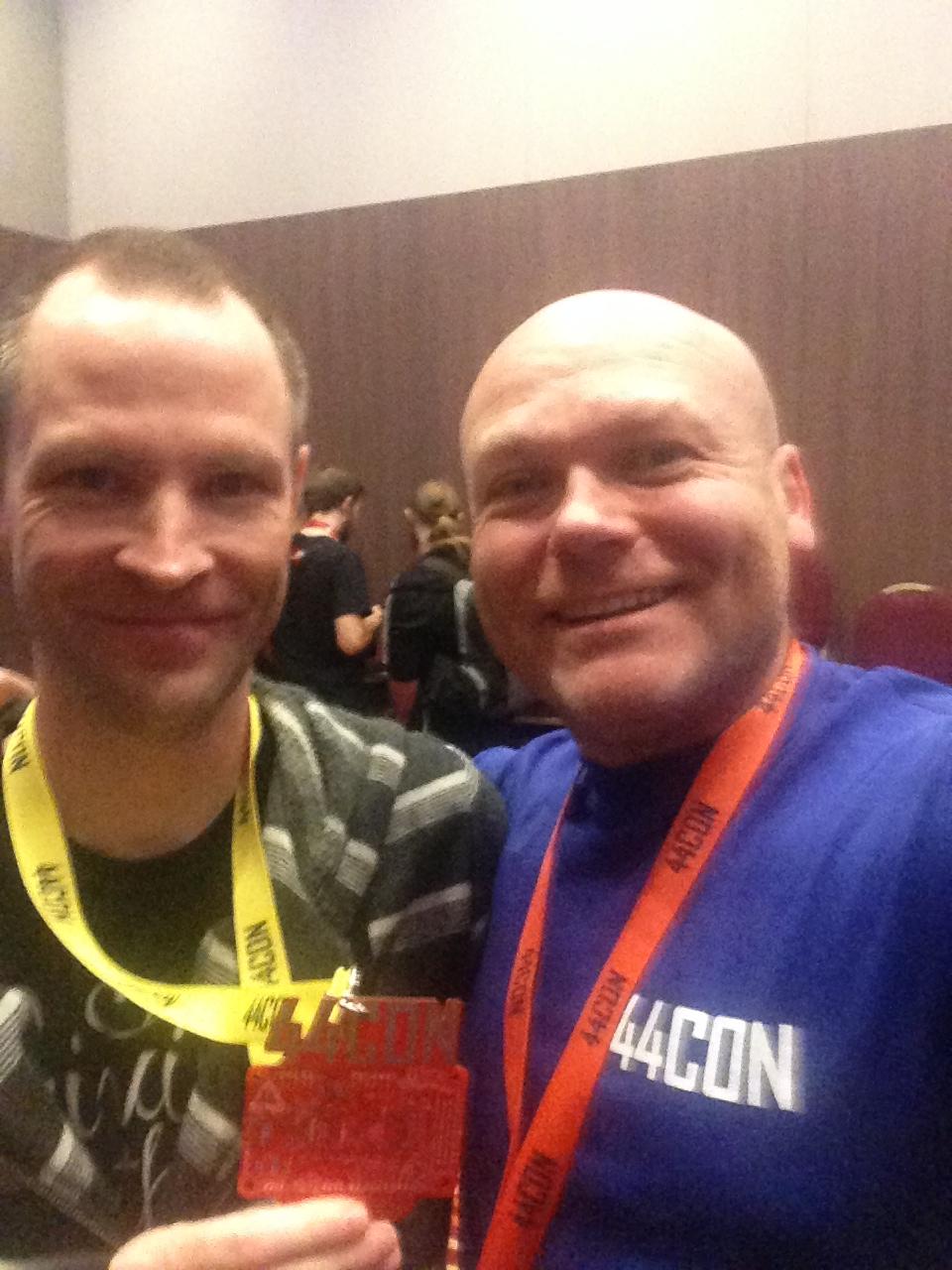
Obligatory selfie with Jonathon Schiefer
The final highlight was to be able to meet Jonathon Schiefer the director of the film Algorithm which had its European debut at 44CON on Wednesday night. It was fascinating to hear about the backstory of the film, his challenges and even how he made the film financially and technically. He was an absolute pleasure to chat with, and I thoroughly regretted my decision to have a curry instead of watching the film. At a stretch you could say we are kindred spirits when it comes to our film making, but he is without a doubt in an entirely different league to me!
44CON will be back next year, but we were also enticed with the news of another 44CON spring conference being planned as well. I would strongly recommend anyone who can get to London to attend both of these conferences. Congratulations to Adrian and Steve and the many people in the crew for putting on a fabulous conference.









 Thom Langford