Charlie & Lola’s Information Security Adventure

lauren_childBeing a frequent traveller, be it train, bus, car or plane, I often get to see people working in all of these environments to one extent or another. From seeing people’s laptops on the front seat of their cars to leaving them unattended in travel lounges, I have seen all sorts of behaviour that we, as information security professionals, would see as unforgivable. We regularly question ourselves as to why this happens, especially when the effects can be so dramatic and have direct impacts on our professional and personal lives.

My most recent example was just last week, sitting opposite a woman who was working on her laptop and referring to a sheaf of A3 colourful papers. They had the unmistakable artwork of Lauren Child, a children’s author and illustrator. As a father of a ten year old and an eight year I recognised the artwork and style immediately as the author of Charlie and Lola, some of my children’s favourite story characters. The papers in questions had plenty of hand drawn mark up on them suggesting this was in the final stages of editing and layout prior to printing, the story itself centering around one Elmore Green who was jealous at the arrival of a younger sibling into his family. It all ends well of course, with Elmore having someone to snuggle with at the end of  the book.

Three things surprised me. Firstly, the way in which the papers in question were left out of the direct sight of the woman concerned, either on a seat on the opposite side of the walkway, or even underneath her own seat (and very accessible from behind). Secondly I was able to discern a large amount of detail from the book in a very short period of time; this is of course partly down to the nature of the book itself, but also, because each page was carefully moved to in turn and then placed somewhere I could review it and even photograph it. Finally, I was alarmed that someone like Lauren Child, who has a very unique and successful place in children’s literature would allow an as yet unpublished book be revealed in public in such a way as this.
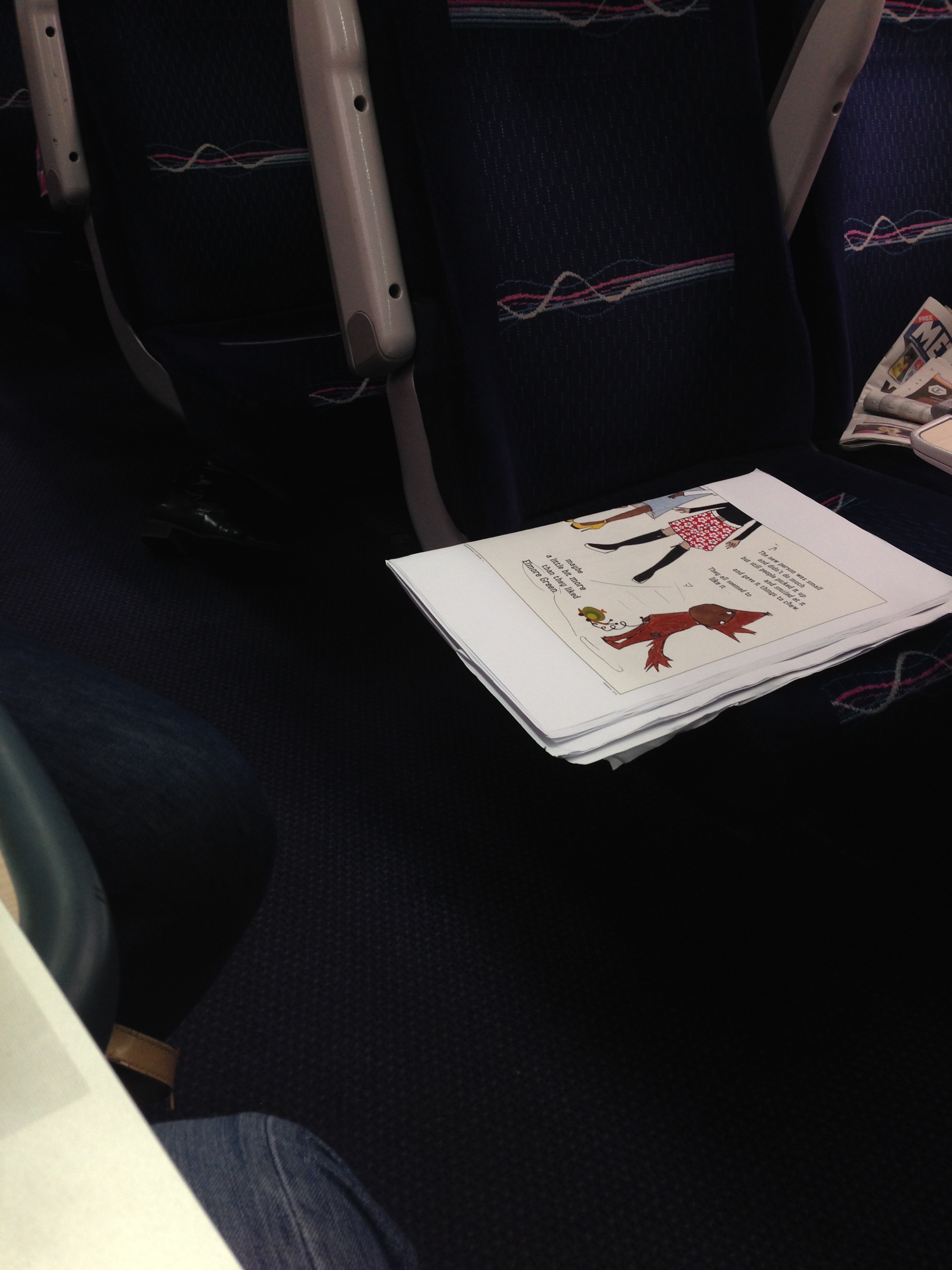
Fingers crossed for Elmore Green!

Fingers crossed for Elmore Green!

This is of course very serious for Lauren Child and her publishers; why was this person allowed to take large copies of this book into a public space? If they knew it needed to be worked on in a train or other public space why weren’t electronic versions made available? Or had they even considered the fact that someone could have easily stolen the manuscript and copied it for an earlier release to capture their particular market?

The implications for UK PLC are probably not that great, and yet examples like this are played out across the country whenever people travel and feel they are in ‘safe‘ environments, with a dangerous cumulative effect for the country. The combined effect of actions like this could potentially add up to the millions in lost opportunities and lost work.  It reminded me of Wendy Nather’s response to a question about public apathy to security, and her surprising yet eerily accurate response was;

I don’t think that society in general will stand up and do something about security until people start dying in enough numbers that it could happen to them individually and not just organizations because we don’t care about organizations.

I sincerely hope Lauren Child has not been hurt by this incident financially or otherwise, she has given too much joy to my children to wish that; but if she reads this I do hope she feels sufficiently motivated to insist on stronger controls around the management of her manuscripts from her publishers.  If you would like some help doing that Lauren, feel free to contact me!


Cross Post – The Human Element

(Originally posted on the Iron Mountain Information Advantage Blog, November 20 2013.)

lost-keys1Leaving things on the train or in a restaurant, or in fact anywhere is an unpleasant fact of life for many of us. I would guess that almost all the readers of this blog have at some point left their keys, wallet, shopping, hat, gloves, children, scarf or phone somewhere or other. On occasion, such lapses in concentration can be upsetting, costly, or embarrassing and in some rare instances even dangerous. But in most cases what we leave behind is either easily replaceable (gloves), insured/covered (bank cards) or worth the cost to change and replace (keys). It’s very rare that we leave and lose something irreplaceable (presumably you found the kids!). This is because the items we treasure often have significant intrinsic and/or emotional value. A good example would be family heirlooms, passed down from generation to generation; we treasure them and therefore take care to protect them, storing them in a safe (or at least a safe place) to be taken out only on special occasions.

What about leaving data somewhere? It wasn’t so long ago, that civil servants and the MOD were criticised frequently in the media for leaving highly sensitive and valuable data exposed in public places. Rarely, it seemed, did a day go by without the Daily Mail bemoaning the inability of the public sector to protect our data. Headlines called for heads to roll. And yet, invariably, these were just the kind of simple, human mistakes that every one of us have made in one way or other. These days, however, the vast majority of data is (or at least should be) encrypted, both when it is on the move and when it’s at rest. Consequently, the loss or theft of encrypted data may now raise fewer eyebrows.

Printed matter, however, is another thing entirely. You can’t encrypt paper documents, and paper is very difficult to secure during transport, without somehow physically attaching it to your person. Taking sensitive documents from one location to another, so often a necessity, quickly becomes a thing of peril. Conceptual drawings, designs, technical drawings, mock ups etc. will often need to be taken to a client site or a manufacturer, and sometimes cannot be sent electronically. After a successful pitch and a few celebratory drinks afterwards those documents could all too easily be left on the night bus to Neasden, unprotected and full of intellectual property and sensitive information. A breach like that can so easily turn a night of celebration into a morning of embarrassment and apologies, followed by the inevitable search for new clients.

Protecting printed documents is difficult, probably more difficult than electronic information, and yet we seem to put all of our efforts into the very latest and best encryption, protected USB keys, and expensive data loss prevention (DLP) initiatives. It’s easier to put in place a technology, especially a “transparent” one than it is to change behaviours.

I would suggest that the information security community needs to address this disparity; the paperless office hasn’t transpired, the digital documents are secured, but paper has been left behind. How can we address this without handcuffing briefcases to people? As usual, it has to come down to awareness, we need to drive home the message that paper should be transported with the same care as electronic records, observing sensible procedures such as ensuring there are always two people present when travelling with paper (to act as more of a reminder than as a physical protection) or even only couriering them with a specially selected and reviewed vendor.

I don’t want to turn the Chief Information and Security Officer into a George Smiley type character, but I do want all of our sensitive records to be treated with the same level of protection irrespective of format.


An Englishman Abroad – Securi-Tay3

Securi-Tay logo - webGavin Holt, who I was fortunate enough to be mentor to for last years BSides London Rookie track, invited me to submit a talk for Securi-Tay3, the third annual security conference hosted by the University of Abertay and run by the Abertay Hackers Society. He is the Vice President of that society and responsible for drumming up trade for the conference. Securi-Tay has a reputation for being Scotland’s biggest security conference, and this year attracted something like 170 people putting it well on a par with many ‘professional’ conferences.

I duly did as I was told and submitted into the CFP.

The day was great; the conference was well managed and run, there were always plenty of volunteers in distinctive blue (and not black for once!) T-shirts who were friendly and willing to help. Vitally there was always a cup of tea available in the reception area, throughout the day, something so many conferences miss when you are working the hallway track rather than the advertised tracks. This is one Englishman who has traditional standards…

As expected there was a very strong technical slant to the presentations (many of them given by people called Rory it seems as well) and some of them were beyond me. In fact I tweeted the following day saying that the one downside to the conference was that I often felt like the dumbest person in the room.

I was able to present on “Throwing Shapes for Better Security Risk Management”, a wholly revamped version of a talk I did at the IT Security Forum late last year. When I first gave it I had some great feedback  from Jitender Arora which I tried to address, as well as the formal feedback from the session (basically “good content but not what was promised”). Securi-Tay kindly recorded the talk which I will post shortly, although with the microphone cutting out there is only so much you can hear. Feedback afterwards was very positive, and I had some great conversations with people not just about risk management but presentation style generally.

Two other presentation also stood out for me; Ritesh Sinha and Paco Hope‘s “The Colour of Your Box: The Art and Science of Security Testing” and Rory McCune’s “Crossing the Mountains of Madness – How to Avoid Being a Security Cultist”. These will also be available at the Securi-Tay YouTube channel shortly.

This was a great conference, attended by people who truly wanted to learn and engage rather than just get out of the office for the day, and who are actively pursuing a career in the infosec industry. What did surprise me though was the number of people from the day who wanted to get more involved with risk management as a career option rather than the more technically focussed, ethical hacking option which at first glance would appear to be the defacto choice. The honesty and passion of all of the students there was very refreshing, and I thoroughly enjoyed chatting to everyone at the after party, all the way through the inevitable kebab on the way back to the hotel.

A big thank you to Gill Chalmers, Gavin Holt and all of the members of the Abertay Ethical Hacking Society for running an educational and excellent day.


An Approach to Risk Decision Making – a Review

Public expenditure

I decided to write a review of a paper submitted to wired.com on the subject of “An Approach to Risk Decision Making” by Curt Dalton. I must however declare an interest in this, in that I happen to report to Curt in my day job (he is global CISO), and that he was kind enough to share drafts with me as he wrote it for feedback. This will of course therefore be a somewhat biased review, although not too much, but I do hope if nothing else it generates conversation around topics and approaches like this. I have a huge respect for Curt, have learnt much from him over the last few years and hope to get a good score in the next performance review!

In essence, this model is designed to help an orgnaisation decide if it is financially viable to invest in security technology/controls/procedures in order to address a given risk. It is not designed to be used across an organisations risk management porogramme, but rather with those handful of risks that can’t be addressed in day to day operations and have to be escalated to senior management to be effectively resolved.  With limited budget and access to that senior leadership, this approach provides support and guidance on what to ‘fix’ and what not to fix.

This scope is a key element of the model; it uses very traditional approaches to monetizing risk versus the more in vogue approach I have reviewed elsewhere in this blog. To that end it uses assigned numerical values to elements of its calculations; this is of course where ‘errors’ may creep in, but in theory an experienced risk manager familiar with their environment should be able to assess this reasonably well.

In summary, the model is as follows:

Figure1_660

Figure 2 in the model requires an analysis of controls required to address a risk.

Figure2_660

This does of course beg the question, how do you know you have all of the controls required and how do you know you have selected the correct numerical value? Again, the pragmatist in me suggests this is entirely possible with someone who is familiar with the environment and the organisation, but this may of course be more difficult in other situations.

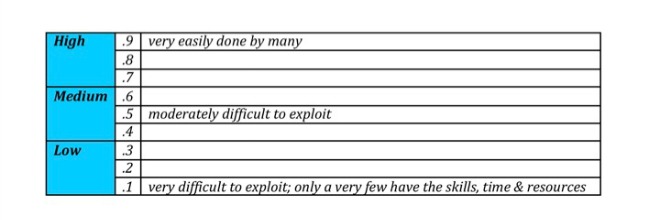
Figure 3 does a similar thing with a similar level of granularity, i.e. defining in nine increments the ease of exploitation of a given risk; where I think there is potentially something missing is that this value applies to ALL of the risks listed in figure 2 rather than individually.

Figure3_660

Obviously this would massively increase the complexity of the solution but this is a deliberate approach to ensure simplicity across the model.

These two numbers are then combined with a simple calculation of impact to etsablish a level of monetized risk. Finally, the 80/20 rule (or Pareto’s Principal) is used as a rule of thunmb to define the actual budget that should be spent to mitigate a risk. In the example given therefore a monetized risk of roughly $1.5m USD should be mitigated by spending up to $380k USD and no more. The Pareto Principal can of course be adjusted accoring to your organisations risk appetite, that is, the more risk averse the organisation the more the rule would move from 80/20 to 70/30 or 60/40 etc..

There are a lot of assumptions used in this model, not least the numerical values that may seem to be arbitrarily assigned. However, I believe this can be forgiven for the very simple reason that this is a pragmatic, transparent and easily understood approach; it can be easily transferred into an Excel spreadsheet meaning that some simple modelling can be carried out. I have said before that until the newer approach to risk management has a more easily understood and implentable approach it will not be adopted. This model does.

The other part to this model that I like is that it is not designed to be a cure all, but rather a tool to help organisations decide where to spend money. If the approach is understood then an informed decision can be made within the constraints of that model (or indeed any other model). I believe it is influenced by the ISO27005 approach to risk management which means many risk management folks will be able to grasp and adopt it more easily.

Overall, this is a model that can be adopted quickly and easily by many organisations, and implemented successfully, as long as its basis in assigning numerical values is understood, and calculations are carried out by those in a position to understand their risk profile well. I would strongly recommend you tai a look at the model yourself over at Wired Innovation Insights.

Pros – easily understand, pragmatic, focussed on one business issue, easily implemented.

Cons – relies on assigning ‘arbitrary’ numerical values, doesn’t address granularity of risk and ease of exploiutation.


Video: Playing the Game of Thrones at RSA Europe 2013

I’m no HBO, but I am pleased to say I have just posted a video of my talk at RSA onto YouTube, entitled “Playing the Game of Thrones; Ensuring the CISO’s Role at the King’s Table. Recorded by my good friend and evil twin brother Kai Roer (@kairoer) it is the session in its entirety along with pertinent slides throughout.

I was pleased with my personal performance at the time, but of course watching it I see many areas I could improve upon. (I am planting my feet better, but still by no means do I stand still for instance.) The staging of the room was very poor, but unfortunately there was not a lot that could be done about that, and many other speakers had to put up with the same issues.

The full abstract for the talk (from the initial submission) is:

Why is is the CISO constantly frsutrated with being required to report to areas of the business that either don’t understand it or conflict with so many of the core deliverables of the role? Too often it is beholden to the agenda of the technology focussed CIO or blinkered by the financial constraints of the CFO. How has the role even got to this place?

Starting with a brief historical look at where the CISO role was borne from in the first place, progression to this current state of affairs is shown to be inevitable.  What is needed is a plan to disrupt this status quo and ensure a CISO is in a position to not only understand the power of the business intelligence that is produced in a well managed environment, but how to ensure it reaches the board in a way that is understood.

Through the use of a universally understood information security model, the CIA triangle, the presentation explores three key areas to assure the success of the CISO in being asked to report to the board rather than being summoned to it.

Initially the actual source of the information, its gathering, the methods employed and the common pitfalls often seen are explored and clarified. What are the common mistakes, how are they rectified and how can you recognise when the data gathering programme is going awry?

Secondly, how is it being pulled together, and what is it saying? How to understand the audience it is being presented to and what can be done to improve its chances of being understood.

Finally, how does the CISO make the final push for the board? What are the key principles that need to be understood about supporting a successful business, what home truths about the information security industry are rarely mentioned and how can the CISO differentiate themselves from those that came before?

This presentation seeks to broaden a CISO’s skills beyond the technical and the post nominal focussed industry accepted norms and into those that actually help a business do what it does best.

The content from this and my other recent talks will start to appear on this blog as I put my ideas down more into the written word rather than a presentation format. I have just one more speaking engagement before the end of the year now, and one in the first two weeks of the new year, so I hope to find more time to write rather than created decks.

I hope you enjoy the video, and as always I would greatly appreciate your feedback both positive and negative/constructive.