RSA 2012 Debate – Should You Train Your Employees On Information Security?

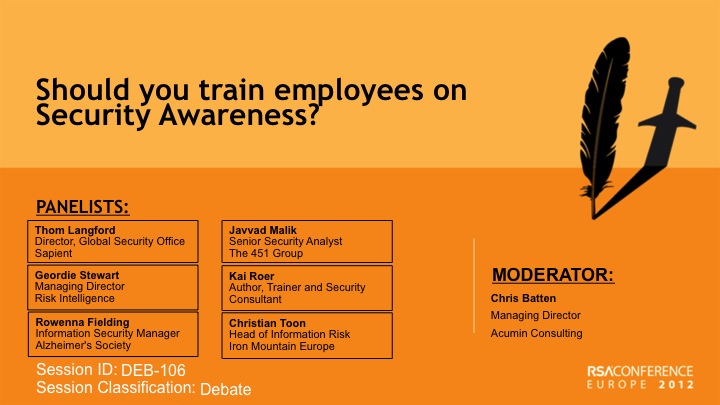
Below are the slides, my argument and some photographs from the debate session at RSA that I was involved in alongside Acumin, Christian Toon, Geordie Stewart, Kai Roer, Rowenna Fielding and Javvad Malik. Obviously by posting it here I am only presenting one side of the argument, but if nothing else I hope to at least stir up the conversation as in reality there is no clear cut answer on this topic. The text itself was my first draft notes and attempt to build an argument; I presented it from memory on the day, so it is obviously not an exact duplicate. I felt I was in a challenging position of not only opening up the argument, but also had no one to put a rebuttal against… at least that is my excuse!

I would very much welcome your thoughts on this somewhat hot topic as well as hear about how you do things differently to ensure the effectiveness of your training programmes.


Being asked to open a debate of this nature is probably challenging enough, but having to tell people that their information security awareness programs don’t work is a bit like telling them that they have an ugly baby; however much it may be true it is not something you can get away with saying very often before someone takes offence… or you get asked to justify yourself in a large public forum.

My colleagues will be presenting their cases far more eruditely than I am about to do so, and given what I suspect the prevailing attitudes in this room are I would therefore ask that you keep an open mind, and ask yourself the awkward questions that our arguments will pose. My arguments stem from the perspective of a poacher turned gamekeeper, so I can confidently vouch for their truthfulness from observations on both sides of the table.

So why am I against information security awareness training? Well, I think the actual term itself is outmoded, and the mechanism by which it is delivered more so. I strongly believe there are three key behaviours that stop the effectiveness of security awareness in its tracks.

Fatigue


Ethics training, anti bribery training, how to submit expenses training, how to work the training system training and goodness knows how many other trainings, and all of these have to be done every year, and more often than not within the same few months during “compliance season”. Is it any surprise that the CBT’s are completed whilst listening to iPod’s, that the “time per slide” statistic is never more than a few seconds and that when it comes to the obligatory questions at the end the cheat sheets get handed out amongst people. People simply can’t take any more!

Do your reported security incidents really go up after your training? Because they should as people become more aware of theirs and others security practices. Or do you still continue to see the same number of malware breakouts, lost USB sticks and laptops “left on the train”, all of the stuff that was happening before. Take a closer look, and see what you can find.

Memory


And with all of this training going on, it would take a full time job to remember it all, let alone trying to retain it in conjunction with their day job. Any kind of training that is carried out needs to be reinforced through regular practice of what has been learnt. But how often do people consciously “practice” their security skills? How often do you hear at the water cooler “I stopped a virus today!”?

Even when this training is put into supposedly professional training packages aimed at companies, they bizarrely even admit that they are not going to be fully successful; in a previous talk I referenced a company that proudly declared that their course would reduce phishing click throughs by 75%. Their course, by their own admittance is ineffective in 25% of cases.

The information security industry has a habit of streaming facts, rules, laws and requirements at people, throwing questions at them and then expecting them to put into their daily work lives. If they are lucky they might get the odd article or even get talked at by someone from IT Security rather wishing they were somewhere else. The marketing and advertising industries clocked onto this years ago, and produce smart, impactful and “sticky” bite sized pieces of information., why haven’t we?

Around, Through and Under


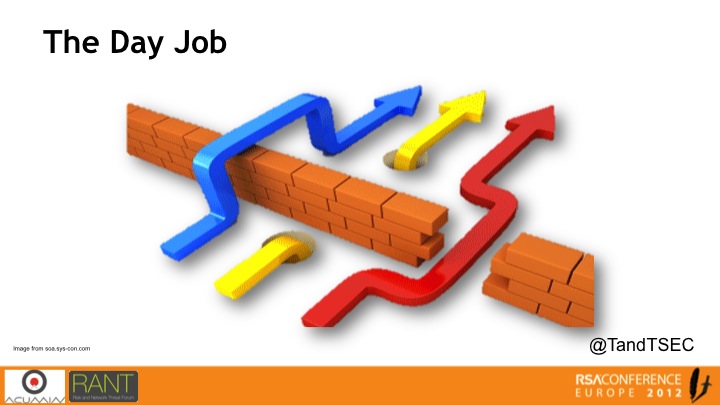
So we now have a picture of people tired of taking yet another training, can barely remember what the training was about anyway, but are also continually under pressure to get their day job done on time and on budget. With these pressures, people are going to be doing whatever it takes to get the job done.

Transferring a large data file to a client at 10 o’clock at night and the IT department have gone home? USB stick or drop box. Having to deal with hundreds of emails day in and day out? Snow blindness to clever phishing emails. Constantly changing workforce due to rapid growth  (or contraction)? Let them in, they need to get their job done just like me. Printers constantly going offline because of under investment? Just keep sending that confidential print job to a different printer until it works, someone else can clear up the spare prints.

Unless their environment is stable, and helps control their actions, or asks them the questions they need to be asked to make an informed decision, people will do whatever it takes to get their job done; the consequences can, and will, be dealt with tomorrow.

In Summary

Until such a time as companies and the security training industry cotton onto this, all your thousands of pounds, dollars or rubles spent on training courses will buy you one thing and one thing only, a tick in the box of your compliance checklist. Is that enough for you, or do you want more

This slideshow requires JavaScript.

(Photos courtesy of David Turner)


That was the week that was – RSA Conference Europe 2012

Having arrived at the Hilton Metropole on Monday lunchtime and finally left the hotel (virtually for the first time) on Friday morning, I am left with a sequence of mad, fascinating, zany, intriguing, bizarre, educational, alcoholic and downright enjoyable experiences. I knew what to expect having attended last year. In no particular order (except by which they fall out of my head) here are my high points, and occasional low points.

Meeting Wendy Nather (@451wendy) of the 451 Group  at last and having lunch with her and Kai Roer (@kairoer, and a constant and welcome companion throughout the week);Dinner at The White Swan with my fellow panellists/debate team, Christian Toon(@christiantoon), Geordie Stewart, Rowenna Fielding (@InfosecGeekLady), Kai Roer, Javvad Malik (@j4vv4d), Gemma Paterson (@GemmaPats) and Chris Batten (@Acumin), and supposedly talking about our debate the next day but actually just sharing inapproriate jokes (mostly led by Chris…); The actual debate itself, not a massive attendance although not only were we up against stiff competition numbers were down somewhat anyway; meeting my first bona fide infosec journalist John Leyden (@jleyden) of The Register as well as my second, Dan Raywood (@DanRaywood) of SC Magazine; Meeting James Lyne (@jameslyne) who is not only a genius but also has the audacity to be charming, funny and an all round lovely guy, goddamm him; Watching Christian Toon bluff his way into the Media/Analysts party on Tuesday night, and watch Javvad have to do nothing to get into the IOActive party on wednesday night because everyone knows him; spending nearly an hour chatting with Javvad talking about blogging, public speaking, charlatans and heroes and being very pleasantly surprised at how much we have in common on these topics; walking out of Bruce Schneiers keynote because I found it dull and unengaging which was a real disappointment; finally making my mind up about Ira Winkler after watching his presentation; wishing I wasn’t late for Josh Corman’s (@JoshCorman) keynote, watching Hugh Johnson again, a master of working the room and engaging his audience, and marvelling at what a thoroughly lovely guy he was; spending time with Brian Honan (@BrianHonan) again and always enjoying his funny yet surprisingly modest company; Eating Schawama’s with Javvad and @sirjester, and subsequently meeting the aforementioned James Lyne and Dan Haywood; failing to win a single thing in any of the prize draws, yet still coming back with five t-shirts and a bag of booty; Watching Javvad and Emma Tweet each other whilst standing side by side; Being amazed, yet finding myself also tweeting almost every 10 minutes in synchronisation with everyone else you happen to be with – what has this world come to?; getting beered up with Chritian Toon on Tuesday and not being able to work out why I feel so drunk and he seems so fresh. The next day it turns out he is nearly 15 years younger than me! I obviously look young for my age, and he the opposite!; Spending a fascinating 90 minutes with Josh Corman on Thursday night and being impressed with how genuine, non judgemental and actually concerned he is about our industry; receiving my first ever Friday Five’s in Twitter and seeing it suddenly explode with activity as everyone joined in, for 10 minutes!; Watching Javvad being awarded his RSA Rockstar t-shirt.

There are many other people I met, chatted with and discussed topics raised in the presentations that are just too numerous to mention. If I have missed you out I apologise profusely and blame my poor memory and being inundated with great times.

The photos throughout this article barely scratch the surface of the fun and educational experience of the week, and I am already looking forward to RSA 2013 in Amsterdam next year!


May I Ask YOU A Question Or Two…?

The iPhone5 launch is very exciting for many people, and I have to admit myself included. Whatever your opinion of that particular can of worms, one thing is for sure, and that is many people will be parting with a lot of money in the next week or two in order to get hold of the latest piece of geek chic.

When there is a likelihood of a money changing hands, scammers and criminals will never be far behind.

I took a phone call (from a UK 0845 number) on my mobile phone on Saturday from someone claiming to be from O2, with an offer to get the new iPhone5 on the day of release without having to queue for hours at my local O2 store. They would even honour the lower retail store price compared to the order online price; on my tariff that meant £70 for the handset rather than £100 because I was a good customer (which I am). What an offer!

Without thinking, I confirmed the first line of my address… and then thought “Oh crap, shouldn’t have done that”; I got a bit carried away. They had called me, not the other way around, I really had no idea who they were!

Cast your mind back a few years ago, and there was a semi legal scam whereby people would take calls from “a representative from <insert mobile provider here>”. They would entice the individual with early upgrades and a new phone, get the verbal agreement, and then shift the contract to a new, third party provider. The downside was that this provider had many hidden charges and an average £25 bill would become £125 overnight partnered with a legally binding contract. This was soon clamped down upon, but this example starting to ring through my mind!

It was at this point that I had verbally agreed that I wanted the new iPhone delivered to my door on a new and cheaper contract this coming Friday… Oh dear God, Have I just committed professional suicide here?!

I turned on my professional brain, and then asked the person at the end if she really was from O2, and obviously she replied “yes!”. So I asked her if she would mind if I asked her a few security questions “of course not, I would do the same!”. i logged onto my O2 account and asked her for my account number, last bill amount and how long I had been a customer. She had all of the information to hand, I was happy, and I am now looking forward to a new phone on Friday (either that or this blog will be closed down on Saturday!).

It did occur to me however that I felt a little awkward asking these questions. How many other people in a similar position, offered an enticing deal would do the same thing? And how often would someone be ripped off as a result. We receive phone calls all the time from our service providers, and very often just asking for innocent information or making sure you are happy with their current deal, but sometimes the first question they ask is a “security” question to confirm you are the correct person. This normal procedure is easily hijacked by social engineers who could over the course of a few months gather a vast amount of information just from phoning you and asking you outright!

Has anybody else experienced this kind of thing? Have you missed some great deals because you missed the opportunity to grab it because you were too suspicious or have you thrown caution to wind only to regret it later, if only for a short period of time? How cautious do we need to be in these circumstances?

One thing I learnt however is that in the middle of a conversation, it is very easy to forget who called who; remembering that if you answer the call you haven’t confirmed their identity and therefore need to ask some security questions of your own is probably  the best way of keeping you out of trouble!


Where is Outlook for iPad?

The prevalence of the “Bring Your Own Device” (BYOD) concept as an acceptable, if little rushed, approach to empowering employees at work has resulted in many different types of devices being used in the workplace now. Arguably, these are split into two camps, Android & iOS (I don’t believe Windows Mobile has made many inroads into the enterprise… yet… watch this space as their new devices come off the production line).

The prevalence of Exchange Servers in the enterprise is also arguable, but in my own experience it is the number one mail server around, and with it of course comes Outlook. On the whole, I love Outlook; it has a few quirks (especially on the Mac) but by bringing together my email, calendar, contacts and notes into a tightly integrated package, which in turn integrates with my enterprise email/messaging/scheduling platform means it is probably the number one application I use.

Why then has Microsoft not capitalised on these two facts and marketed Outlook for mobile devices with the promise of integration, functionality and security? There are apps on the various app stores that claim to offer Outlook style experiences, but the feedback on these speaks for itself.

I can’t say I would care much for Word, Excel & Powerpoint on my tablet that much, I tend not to edit or annotate these documents on these devices much anyway. But Outlook would change how I interact with work over my iPad, but only if they implement it properly!

Given one of the core tenets of Outlook is to integrate email, contacts, calendar and notes from the enterprise, I strongly believe it should NOT integrate with the same apps on the device. By this I mean its database should be entirely separate, and ideally, encrypted to retain a certain degree of security. Because of this separate installation, the application itself can handle all of the ActiveSync profiling (e.g. encryption, password protection, password retries, remote wipe and the such like) that on existing devices causes an infinite amount of pain. Having had personal experience of rolling out a one size fits all ActiveSync profile to thousands of of BYOD devices with different hardware and firmware because they are by definition “personal” devices, I know too well of the amount of noise, frustration and lost hours this brings to the end user.

Of course, this kind of application, sold on the app stores for £10GBP/$15USD, could also be purchased by the individual owner and expensed (or not, see your expense policy) and is the one, and only, barrier the enterprise puts up to mobile BYOD adoption. Have the latest Outlook for iOS? Then gorge yourself on your work email to your hearts content! The enterprise has full control over the data, including rules of what can be forwarded, printed etc because it does not integrate with the devices native apps, and if the employee leaves or is fired, then ZAP! on the next connection and authentication the data is gone.

This approach may put companies like Good out of business, or may even drive them to greater innovation (where do you think I got the idea for the above anyway?!), but my experience of bolting on third party products onto Exchange has never been “good” anyway.

In my limited experience I know there must be some pretty major road blocks to this, otherwise why haven’t they done it already? If you are more educated in this area than me then please do comment and let me know your perspective. in the meantime, I shall dream of my iPad/Outlook nirvana and the increased amount of sleep I will get overnight not worrying about all that data flying around on peoples personal devices.


Open Letter to Apple – Why Have You Forsaken Me?

Dear Apple,

Your new MacBook Pro’s rock… the screen alone is just like moving from black and white to colour, and with the Air-like instant on, solid state disk and all round grooviness I nearly sold a kidney there and then (thank goodness the market in kidneys crashed; this could have been a very different letter).

And then, I saw it. Or more accurately I didn’t. The lozenge shaped hole of hope, that sliver of sanity, the goddam lock lead hole… It wasn’t there; in fact I looked again and it still isn’t there!

WTF Apple? What kind of insane douchebaggery is this?

You have strived and toiled and driven to be accepted into the enterprise. You have integrated with Microsoft Exchange, AD and even licensed ActiveSync for the iPhone. You have built in full disk encryption into your OS(X), allowed corporate Microsoft into your walled garden and introduced Employee Purchase Programs. In fact, you sounded like my hip godfather; all grown up and wise and everything, and yet still somewhat cool and groovy.

I even use a MacBook Pro at work for goodness sake! You make ME look cool and hipster like, and THAT is hard work I can tell you…

I tell people about how much more stable OSX is, how much more consistent the hardware is and how much more intuitive the interface is. Sure, your enterprise hardware support isn’t as good as say HP’s and Lenovo, but it is good enough, and at a pinch I just wander up to Oxford Street and chat to a Genius and they fix it anyway.
And then you announce the retina display, and all the other coolness that goes along with the new MacBooks; everyone in the office is talking about how they need one, my work and productivity depend on it, and you know what?… I ignored them because I needed one and my productivity suddenly depended on one as well…

And when I didn’t see that hole of hope, I think I died a little inside, and not just because I couldn’t lock my laptop up now, but because I will never be able to lock it in the future. This is obviously a design decision, one that was actually thought out, not just forgotten.

I have fought and fought to get my people to understand the importance of basic DLP, that is, lock your frickin laptop up, and your data will not literally walk out of the door. And in one fell swoop, you have told all of my MacBook users that it’s OK not to have a laptop lock. “If Apple don’t think it is important, why should I listen to you?”.

Godammit.

I now have to fight for extra budget for a case that screws into the chassis of the laptop that I can lock a lead to (ugly) or pieces of metal to slip between the hinge for the lock lead to attach to (screen crunchingly efficient) to get a basic security control in place. And I bet the answer will be “no” – these new Macs are expensive enough, we have encryption, why bother? Ummm, downtime, productivity, overhead of security incident reporting, cost of hardware replacement and just generally lax security practises (or “risk homeostasis” – a topic of a forthcoming presentation).

You have two choices; either reintroduce said hole, or introduce the most amazingly designed and fabulous looking security device for these laptops that I will spill £50 of my own money to buy one.

Do you dare to “think different” in this regard…

Yours sincerely,

Thom “lockless” Langford