Getting Ahead in Information Security

getting ahead

(Originally Posted on the VIA Resources Blog here.)

Advancing your career in information security, let alone getting a job in it in the first place is challenging and sometimes overwhelming at best. It can often feel like an exclusive club that is hard to break into, and the “elder statesmen” of the community distant and aloof. With these kind of barriers where do you even start to try and network and make contact with people who could not only progress your career but also start it?
The real answer at first appears flippant; if you want to be a part of a community you need to engage with it and join in. Obviously, that is harder than it seems, so here are three ways you can help yourself to getting ahead in Information Security:

1. Start attending the many free events that are held every week.
There are plenty of these around, you just have to look for them, such as (ISC)2 and ISACA events, plenty of sponsor driven events and community driven events. Europe’s largest information security event, Infosecurity Europe is a free three day event which not only gives you access to all of the vendors out there, but also an excellent education programme. Traditionally on the same week there is also BSides London, a free one days event, although this one is ticketed. Not in London? Then consider BSides ManchesterSteelCon and SecuriTay. Seek them out and you will find them. Not in the UK, then Google is your friend.

2. Attend some of the bigger, paid for conferences.
Obviously this is not always easy, especially given the price of the tickets and the whole reason you are reading this is that you need a job! All of these conferences require a huge amount of effort and willpower to get them to run smoothly on the day, and many of them require… volunteers. 44CON has one of the best volunteer crew programmes I have come across, with plenty of perks available. By volunteering for these events you are not only showing yourself to be a stand-up member of the community, willing to help out and contribute, but you will also get unprecedented access to the attendees, speakers and organisers. They are yours for the networking!

3. Contribute to the community.
This could be anything from volunteering (above), blogging, tweeting, offering to speak, writing articles for the various community news outlets, in fact anything that gets your name out there. Submit in the variety of Call for Papers (CfP) and you normally get a free ticket, and sometimes travel expenses paid too. Depending upon your grammatical and public speaking skills, this could be very tough but who said progressing your career was easy? Being able to articulate your personal opinions on the often very contentious issues in the industry is an excellent way of improving your ability to assimilate, process and form your own opinions and views for the benefit of the community. What better way of getting known in the industry?

All of the above require time dedication and effort, but since this is your career we are talking about, are these too much to ask?


An open letter to Apple – a change of heart

overcome-regretDear Apple,

I wrote to you back in 2012, deriding your decision to remove the lock lead security hole on your laptops. I may even have been a little rude.

An epiphany of sorts has happened to me at some point over the last few years though, and I think it stemmed from your decision to remove the security hole. Back then, I argued that physical loss of an asset was still bad, even with encryption enabled, because of downtime, replacement costs etc.. It also, I argued, helped to instill a culture of security in people as the physical act of locking their laptop would also remind them of their other security obligations, a constant reminder pif you will.

I was wrong.

The lock lead has been seen as barrier to productivity as our workplaces have changed and our people have become more mobile. People have avoided using them, or evened cursed them because their offices didn’t take the relevant logical step of ensuring there were adequate anchor points to be used. People were moving from one room to another on a regular basis for their meetings, and locking and unlocking their laptop reminded them of how out of touch security was with the realities of daily life.

I even did a back of a napkin calculation; a company with 10,000 laptops would spend (roughly) about $500k USD every three years on lock leads. That same company may experience thefts that could have been prevented by a lock lead that would total less that $10k a year. Financially this no longer makes sense. My inner chimp was scared that laptops would simply be stolen regularly from our offices and if I didn’t do anything about it I would get fired. In fact, decisions like this are costing our companies hundreds of thousands of dollars off the bottom line. So much being a “business enabler”.

So I take it back, all of it, and I want to thank you for setting me on the right path (and saving us all lots of money).

Your sincerely,

Thom “with regret” Langford


Risk, Rubble and Investment

rubbleOriginally written and posted October 13th 2014 on the InfoSecurity 2014 Blog (and reiterating a pet core message of mine  again!).

Risk is a bad thing. Therefore risk needs to be reduced to rubble, or even better to dust and then swept away under the carpet never to be seen again.

This is the attitude that many of us have, and then pass onto our senior leadership when it comes to information security programs. “Invest £10 million and we will buy technology that will make us safe” we have often said in the past. “My blinky boxes will soon find your risks and reduce them to nothing!”. It should be no surprise for so many of our industry therefore that CISO stands for “Career Is So Over”.

What we often fail to appreciate is that the senior leadership and boards of virtually all organizations understand risk far better than us. They deal with financial, legal, HR and international risk on a regular basis, and know how to take advantage of it to their benefit. Their advisors in the various fields know how to communicate their unit risks in a way that makes sense to business, be it financial, reputational or whatever else makes sense in their industry. The leadership do not require specialist knowledge of these areas because the risk is being translated into terms they understand.

The information security industry however still often talks in terms of “APT’s”, “DLP”, “TLS” and other obscure TLA’s* while trying to explain why more money is needed to “secure all the things”. What is the benefit to the business? What is the real risk in terms everyone can understand? Translating these technical issues and risks into business risks has always been a challenge and has often resulted in information security being perceived as the “expensive part of IT” asking for more money with little positive influence to the business.

If you work in a brewery, the ultimate goal of everyone who works there should be to sell more beer. If you work for Oxfam, the ultimate goal is to get aid to those that need it as quickly, effectively and efficiently as possible. If you work in a publicly listed company, the ultimate goal is to make more money for the shareholders. The role of information security within any organization is not exempt from this; security doesn’t get a special pass because it is, well, security. The role of the information security function is to support the ultimate goal of the organization it operates in.

Understand what your ultimate goal is. Focus your strategy on ensuring you are helping meet that goal. Be willing to compromise in certain areas of security if it helps meet that goal. Ensure you senior leadership understand the risks (in their language, not yours) involved in those compromises. if you don’t get what you want then move onto the next piece of work that supports your ultimate goals (or be prepared to fight harder and more lucidly for your original cause).

If it was that easy you wouldn’t be reading this, but surely it is easier than the ongoing battle for investment that we ultimately never win anyway?

*Three Letter Acronyms (surely you know that?)


Computing SecurityNote: Many of you know I was up for the “Personal Contribution to IT Security” Award at the recent Computing Security Awards. I was (un)fortunately Runner Up in this category, but thank you again to all of you who not only may have voted for me but also nominated me in the first place. It was a wonderful evening with good friends from my work and InfoSec life, and a good excuse to dress up in my best party frock. Here’s to next year!

IMG_4119


Flushing Risk at 44CON

logo-1I have just returned from two long days and two long nights of 44CON, the premier conference in London for technical InfoSec professionals (and even a few of us management types). It saw the debut of by “Flushing Away Preconceptions of Risk” presentation, an expansion of the my recent post for the Analogies Project.

The core messages of the presentation are not necessarily pleasant ones; the correct use of risk in any organisation is one of the most powerful tools in an information security programme, and yet it seems to me that very few of us understand it fully. Many of us struggle with not only identifying what the real risks are in the first place, but also how to measure them and even how to properly treat them.

Doing my bit to advertise 44CON

Doing my bit to advertise 44CON

Identifying risks at first seems like an easy think – identify assets, and then identify what could go wrong. I won’t elaborate the analogy much here (read it at the Analogies Project), but given how we regularly fail to identify risky behaviours correctly in our daily lives it should be no surprise we fail to do so professionally. The same bias applies to when we subsequently try and measure the risks; every mechanism we use introduces potential errors and even vagueness. I was quite proud to introduce the Langford/Malik Risk Model (ver 1.0), an approach that I evolved from one that Javvad Malik introduced in his book. Again, it uses an analogy although this time of a pub fight to not only describe levels of risk but also risk appetite. I do hope that not too many of you will find it useful next Friday and Saturday night.

ThomLangford_2014-Sep-08

The Langford/Malik Risk Model ver 1.0

Finally the effective treatment of risk was covered, and how we so often simply do what has been done before, not what is going to be effective now. Just because a risk hasn’t been realised doesn’t mean you have treated it effectively, it just means that an incident hasn’t happened (that you know of).

The slides are below, but since my presentation style has evolved more into storytelling rather than bullet point reading, by themselves they may say little to you, but the session was recorded and when it is released I will make it available here. Like any presentation it barely touches the surface of risk management and its issues, but it was intended to be thought provoking and prompt people to not assume that just because they have always done things in a certain way that it is the best or even correct way.

This slideshow requires JavaScript.

As for 44CON itself, well, any conference that has a “gin o’clock” on each day has to be pretty good in my books! It was a very well organised conference, with an excellent and highly motivated Crew to help support it. SpeakerOps were particularly good providing a personal touch I have not seen at any other conference. The quality of the talks and the speakers was also excellent, but as I alluded to in my introduction, many of them were technically beyond me!

The highlight for me however was a workshop I attended demonstrating the beta version of the Cyber CPR product. This is a virtual machine (that can also be deployed on ultra portable hardware if need be) that builds and entire incident management environment allowing for the discovery, gathering and analysis of evidence during an incident. It build a virtual “war room” environment, where multiple incidents can be tracked at once, in a secure and separate environment from the one that has actually just been breached. With tools built into the backend and access via a browser it even does away to have many of the tools on your own environment, making it great for remote and ad hoc use alike.

The product is in Beta at the moment, and does lack a few features, (they described it as not ready for active duty), but what i saw  was very polished and useful even in it’s beta configuration. Commercially it will be available for free with up to three users, and only $5k GBP for up to twenty (please don’t quote me on these figures though). I would strongly recommend you take a look at this excellent environment that for very little outlay will significantly improve many current incident response teams, and their over use of Excel. The team expects it to be commercially ready by Spring next year.

ThomLangford_2014-Sep-13

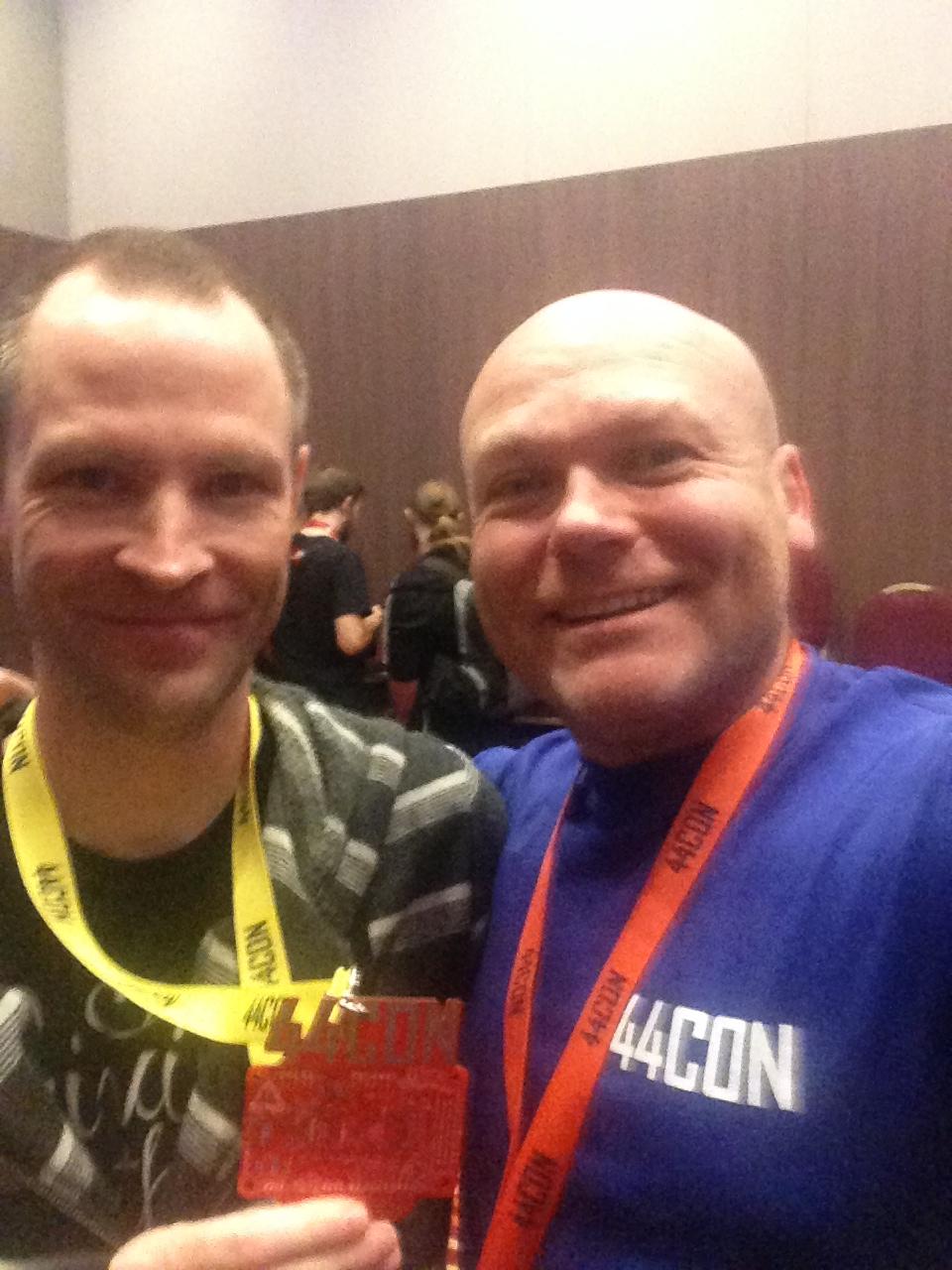
Obligatory selfie with Jonathon Schiefer

The final highlight was to be able to meet Jonathon Schiefer  the director of the film Algorithm  which had its European debut at 44CON on Wednesday night. It was fascinating to hear about the backstory of the film, his challenges and even how he made the film financially and technically. He was an absolute pleasure to chat with, and I thoroughly regretted my decision to have a curry instead of watching the film. At a stretch you could say we are kindred spirits when it comes to our film making, but he is without a doubt in an entirely different league to me!

44CON will be back next year, but we were also enticed with the news of another 44CON spring conference being planned as well. I would strongly recommend anyone who can get to London to attend both of these conferences. Congratulations to Adrian and Steve and the many people in the crew for putting on a fabulous conference.


What My Tailor Taught Me About Value

0130bespoke01_G_20110131021109Do you really understand the value of the data in your organisation? Some of it is fairly straightforwards, such as personally identifiable information (PII) and/or credit card information ($188 USD per record in direct and indirect costs to the organisation for every record lost was the figure I last heard and used).

What about your intellectual property though? Or client RFP’s and and pre-sales work left on the train? Salary information? Internal network architecture diagrams? Sometimes, when this information is lost it is difficult to ascertain its value,  impact to you and your organisation and therefore the scale of your response.

I was reminded of this value quandary while I was having a second fitting on a suit I was having made at the shop of Charlie Allen in Islington. Before anyone makes a judgement on my salary, the suit was a very welcome prize from my time at the InfoSecurity show in April, from the good folks at Sestus. I have had suits made before, normally in India, but this was my first suit to be made wholly in England and knew there would be a difference in price if i were to pay for it myself. After the fitting I asked to be measured up for some new shirts; I thought I would treat myself and take advantage of the time in Charlie’s studio. I checked the price of £200 with a minimum order of three. Good value I thought, three shirts for £200. It was only after the fabric selection, design, measurements etc the invoice came… The shirts were £200 each, a total of £600. I very nearly handed over my credit card simply to avoid the humiliation of admitting my mistake and exposing myself as someone who quite obviously shops in Top Man.

Blustering my apologies, I mentioned something about obviously not understanding the true value of these shirts, asked for the quote to be put on file for “later” (i.e. when I win the lottery) and made a quick exit. However, as I walked back to the office I realised that it was obviously going to be £200 each; a good quality short from Thomas Pink off the peg costs between £80 and £100 each, therefore how can three made to measure shirts cost £200? I had woefully underestimated the value of something that was actually quite obvious in hindsight.

So what? Understanding your information assets, and their value is a table stakes exercise. Doing this will allow you to do two things;

  1. Understand the total value of your assets and use the figure to work out what kind of exposure your organisation is likely to experience in case of a breach.
  2. Subsequently use this information to build a realistic business case for protective and preventative measures to avoid that breach in the first place.
  3. Ensure the scale of your response when those assets are compromised is commensurate to their value.

There are plenty of good resources to help guide you on this, but one of the most important pieces of the puzzle is to understand the financial value of your assets in the first place, and certainly not after a breach.