Amsterdam has them now: RSA Europe 2013 and playing the Game of Thrones

IMG_2991As usual it was a great week at RSA Europe, as much for the hallways track as all the other tracks on offer. Whilst it may not be as large as it’s bigger brother in San Francisco the move to Amsterdam from London seems to have given the conference a new sense of purpose and scale. The potential to grow in this location is obvious. But I hope it doesn’t grow too much more; there was always a sense of knowing what was going on and when, and where you were in relation to the auditoriums and speakers. I am sure that sense of perspective is more than lost in the scale of RSA San Francisco.

It still had it’s challenges, all minor. For instance, tea and coffee points that seemed perpetually shut throughout the day, a distinct lack of activities on Wednesday even after a 17:00hrs close, and perhaps the location did not lend itself to the kind of out of hours socialising that London had to offer. For me the Novotel bar became the centre of my networking experience, no bad thing, but I would wager there were a few more hotel bars doing the same thing meaning the networking was seriously fragmented.

The usual suspects were there for me to socialise with as well as some new faces, such as Tor and Kjetil from Norway who were both intelligent and hilarious, a combination I always enjoy. I managed to meet a few more of our industry “luminaries” as well which is always interesting (never meet your heroes!), as well as catch up with others I had met previously and enjoyed their company and insights.

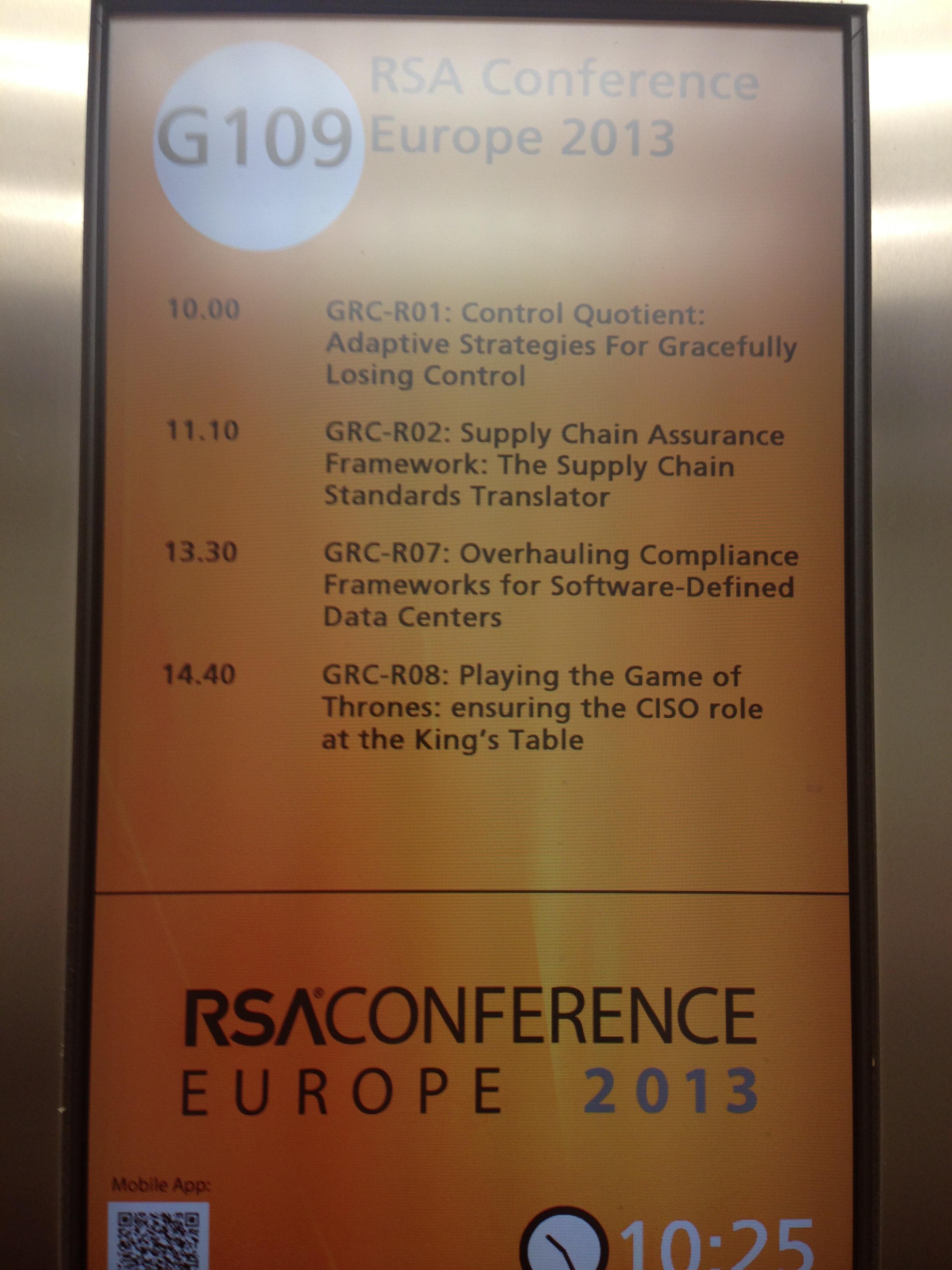
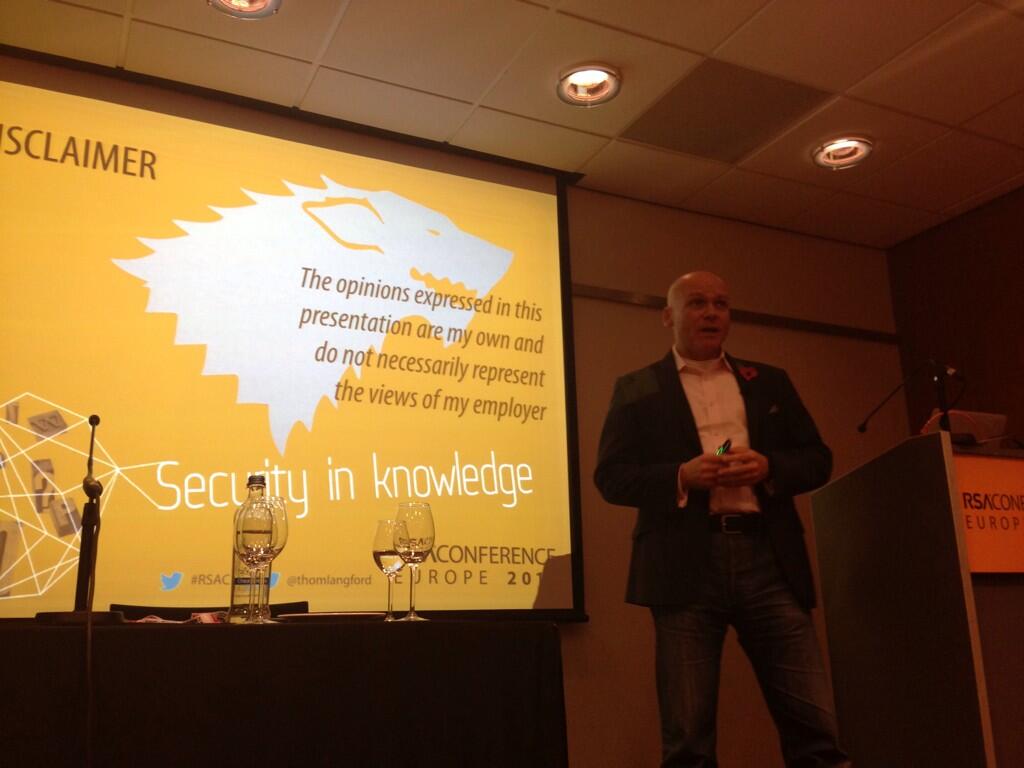
IMG_2998For me the whole conference was focused upon 14:40hrs on the Thursday when I presented “Playing the Game of Thrones: Ensuring the CISO’s Role at the King’s Table”. Not only was I presenting in my own right but I was also presenting content and an approach that I had synthesised from a variety of sources and my previous thoughts and theories. The session went extremely well, was watched by a number of people I know and respect, and was fully attended (with even a couple of people having to stand). Questions at the end were thin on the ground although I had noticed that throughout the conference, but the feedback has been phenomenal. I haven’t had the formal feedback from RSA yet, but their newly introduced conference app allows me to see a certain degree of feedback on both me as a speaker as well as the talk itself.

RSAC Europe 2013 GRC-R08 THOM LANGFORD.005

The slides are above in PDF format, and are also available in Keynote format here. My good friend and evil twin brother Kai Roer kindly filmed the talk as well, and as soon as that is available I will be publishing that on YouTube. One of the key reasons for doing so is to invite more comments on the material itself, as I made a few bold statements that I am sure not everyone would agree with. For instance, the less influence a CISO has, the more prescriptive (and lengthy) the policies are, in turn making them less effectives. This is based on my observations only rather than research, so getting feedback on points such as this helps inform everybody more.

All in all it was a great week, making new friends and meeting old ones and always learning new things almost every hour. Here is my honour roll of folks from the week that made it as memorable as always:

Javvad, Brian, Kai, Kjetil, Tor, David, Dave, Bruce, Tor, John, Dwayne, Quentyn, Neira, Josh, Martin, David & Olivier (my apologies to anyone I left out, it is the fault of my memory and not how memorable your were!).


Announcements, Presentations and Work!

Banyan tree, Bangalore, India

Banyan tree, Bangalore, India

It has been an incredibly busy five weeks since 44CON, with a lot of travel, projects coming to fruition, conference talks and preparation as well as more writing than is reflected in this blog.

I have spent three weeks (over two trips) in India carrying out five security risk assessments and hosting one three day client visit, and all I can say is that my India based colleagues continue to impress and amaze me with their knowledge, analytical skills and above all friendliness. I had the good fortune to spend some time with them at a team outing, discovered a mutual friend in London and also hit the dancefloor with them (if you have never danced in an Indian nightclub, you haven’t really danced!).

I was also able to spend an evening with the lovely folks of the Delhi chapter of NULL in Noida, and had a great couple of presentations (WAF and compliance) as well as an engaging conversation on interviewing in the infosec world. I had struggled for the last couple of years to find good conferences and forums in India, but apparently I missed an incredibly vibrant and widespread community. I’m glad to ay that is no more the case and I look forward to attending more in the future (along with my India based colleagues). On my return I attended the IT Security Forum and spoke on “Throwing Shapes for Better Security Risk Management” covering three ways to manage your security programmes more effectively.

A project I have been working on with my good friends and colleagues @sirjester and @j4vv4d finally came to fruition with the help of @jimshout, called Host Unknown. I am extremely proud of this project and we have spent many hours agonising over the details, honing the performances and getting website, YouTube and social media coordinated; in fact it was a lot more work than we expected! There is so much more in the pipeline, and if you would like more information please contact us, I promise you will only be mildly disappointed! (I am also legally obliged to point out that it was all my idea, despite what some of you may have heard.)

My other piece of news is that I have been asked to be a guest blogger for Iron Mountain, something I am absolutely thrilled by! I have already posted my first article, and I am looking forward to writing many more. As someone who can often struggles to  get down to the process of actually writing int he first place, (once I am started I seem to be OK!) I see this another incentive to flex that particular creative muscle more frequently, as well as getting used to writing on specific subjects, somewhat to order. I will of course be cross posting back to this blog, but I would encourage you all to head over and see what they have to say. My particular favourite is @christiantoon who is certainly one of the more prolific writer on the site (and a great guy to boot!).

It’s the RSA Europe conference next week, and I have been busy preparing my presentation “Playing the Game of Thrones: ensuring the CISO role at the King’s Table”. While there is an element of content that I have covered in other presentations before, this is nonetheless a new presentation with plenty of new content, somewhat more research based (although by no means academic) and very much pushing me out of my comfort zone. That said I think it is going to be a strong presentation which should generate some good discussion; here’s a podcast where I explain what I am going to be talking about, and I will of course be covering the conference in my next blog.

With all of this going on I haven’t been able to post as regularly as I would have liked, but I am building up a great stash of content that should see us through the winter months. Winter is coming after all!


What’s this security stuff for anyway?

I am currently sitting in the BA lounge in Heathrow awaiting a flight to Delhi, and as I look around at the number of laptops lying around it reminded me of something I saw a few years ago at Delhi International Airport as I was waiting to fly back to the UK. It was so shocking I even used it as an example in a security article I wrote for my company on my return. Regular readers will know that I have a thing about unattended laptops anyway as it  has the potential of negating all of the technical measures put in place in certain circumstances. Anyway, I decided to write it up here as an example (and of course to kill the time in the lounge!).

It was about midnight, and I was in the BA lounge (sometimes shared with other airlines), and it was quite a busy evening so most of the seats were taken.

I was sat next to a gentleman who opened up his laptop and switched it on. It immediately asked for a password, I presume for the on disk encryption. He then had to log into his account, and then finally he connected his own data card (no local WiFi and inherent insecurities for him!) and subsequently connected to his corporate VPN using a username, password and an RSA two factor authentication token. All good stuff from a security perspective.

I noticed from his wallpaper logo right in the centre of his screen that he worked for an aeronautics defense contractor, so the level of security didn’t surprise me. What he did next however did…

After successfully connecting, he placed his laptop on on the table in front of him and went to the toilet… without even locking his laptop. He was away for 15 minutes.

I was so shocked I even took a photo of his laptop which is attached – this is honestly the laptop in question! If you look carefully you can see the window with his VPN connections in the middle of the screen

image

It summed up to me that even though there was all of this security on his laptop, it was rendered useless by his carelessness and utter disregard (or utter lack of awareness) of the security of the contents on his laptop. He entered the passwords that protected his data because that was what he needed to do to get his job done, not because he understood what it was for.

When we overcome scenarios, attitudes and understanding that results in this kind of thing being played out the world over, we will have addressed a huge amount of risk in our industry.

Bon voyage!


Sailing the High Seas at 44CON

logo-1I have just returned from 44CON, a technical infosec conference that is held in London and in its third year. As with any multi day conference you come back tired but educated, and happy but deflated that it is over. A speaker party, a conference after party, two gin’o clocks, a conference bar and some fabulous presentations makes for an exhausting two days.

Organisationally it is extremely well run; the crew are are friendly, knowledgable AND efficient (it’s rare to have all three), the venue is of a high quality, the sponsors are low key but available, SpeakerOps is excellent, and with the exception of myself and two others the attendees are amazingly smart and technical. I was able to chat to a number of the speakers at a reception on Wednesday night, and the level of detail they went into for their research was simply mind-blowing; one person even decided to write his own 3D presentation language instead of using PowerPoint or Keynote, just for this one presentation!

I spent the first day mostly at the InfoSec track rather than the technical track, learning about “Security lessons from dictators in history” and “Surviving the 0-day – reducing the window of exposure”, both very good. I did attend a technical talk in the afternoon along with two friends (the two mentioned above!), and to be honest he could have been speaking a different language with what he was talking about; to make it worse he apologised at the end for not making it technical enough! It was a fabulous talk though, wonderfully presented, and let down only by my lack of technical knowledge of the subject.

As a backup speaker for the infosec track I thought I was off the hook at this point as nobody had dropped out, but it was announced at this point that there would be a “hidden track” of talks, of which I was one of them. This hidden track would take place at an undisclosed location and you had to talk to vendors and other con goers to find out where it was. It was at this point I excused from the after party to add a little more content to my slides.

Sailing the Cs of Disaster Planning 44Con.001

Sailing the High C’s of Disaster Planning – Click for PDF

The following morning, after the opening presentation I was second in the hidden track. My talk was entitled “Sailing the C’s of Disaster Planning”, and the main drive of it was of a simple “framework” that allows you to be be able to not only test the effectiveness of your disaster/business continuity planning, but also help to communicate the key elements of the plan upwards to the board and down through the key players in the organisation. This was the first time I had given this talk, and to be honest some of the ideas have not quite been fleshed out, although the concept is sound. It was well received by about 20 people (not bad given it was a hidden track) and there were some good questions and conversations afterwards. Feedback received later in the day was both encouraging but also useful in highlighting areas that need to be improved.

A copy of the slides are above; if you take a look at them please provide feedback as always (caution, 12.5Mb PDF).

I will be using this blog to flesh out those ideas and gather feedback over the next couple of months, firstly by looking at the high level concepts of this approach, and then subsequently break down the five elements of the approach into further blog posts.

The remainder of the second day at 44CON was taken up with more talks, as well as a bit of filming with my two colleagues, the two unknown hosts you could say, for something we hope to release in the next few weeks.

I would like to thank Steve and Adrian and the entire crew of 44CON for an excellent event, and I am certainly coming back for next year, at a new, larger yet undisclosed location.


The different view of risk modelling

Traffic lightAs someone whose primary function at work is the ‘management’ of risk in all of its glorious forms, I have over the years become very comfortable with its accepted definition and how to measure it. ISO 27005:2008 was my bible, giving me the flexibility to choose a schema that worked for my particular environment as well as the credence that I was doing it right. I always knew that assigning arbitrary numbers to things wasn’t exactly the most scientific way of actually measuring something, but I could deal with that by simply talking about “indicative values” and “helps with prioritisation”.

It was a little under two years ago at the RSA conference that I attended a talk entitled “Pimp My Risk Model: Getting Resilient in a Complex World” by David Porter, and he spoke about a new approach to risk modelling. Rather than focussing on what could happen, and then play that through to the conclusion of an impact that is then measured, it instead focussed on what the desirable outcomes were in the first place and then worked backwards establishing what was required to achieve them, basically dependency modelling. Not only was this more efficient and scalable as not all permutations of threat/vulnerability/asset (for instance) are required to be worked out, it provides better information for early decision making.

The concept is not new, and has its roots in the late last century in the financial markets/actuaries who were looking at better ways to model and manage risk.

There are a number of proponents to this approach, all of whom have a far better understanding than me of this approach, but despite this in the last two years I have simply not seen it in a practical form that can be used every day. Unfortunately, and I am sure I am not alone here, if I can’t implement it quickly it gets passed over for the next best thing that can be. In fact, and perhaps in my own blinkered universe, the approach itself barely raised a murmour since. And yet the concept had stuck with me especially on the few occasions when I had heard it talked about.

It was on Russell Thomas’s blog, exploringpossibilityspace, that I saw just the other day this very approach being touted again. What I enjoyed about this post was the balanced and educational view of the traditional approach (little “r” approach in Russells’s parlance) versus the new dependency modeling approach (big “R”). I think the criticism of ‘r” methods is well founded, although it is widely understood in business and when used properly can help produce at the very least tactical indicators of risk to the business.

My challenge with the ‘R’ approach is that I have yet to see it applied in practical terms and in a way that is easy to digest and understand (I think I hurt myself about two thirds of the way down the article trying to get to grips with the concepts!). As a result therefore, getting business buy in is going to be extremely challenging. Partial information from an ‘r’ approach reaching the business successfully is going to be better than no information from an ‘R’ approach (however better the data is) reaching the business.

I would strongly recommend everyone to read Russell’s writings on this risak model, which also contains links to other resources as well.

There is more work to be done, but I hope it focuses on making it possible to use the approaching a day to day environment; they say there is nothing new in the world of information security, but I have high hopes for an approach to risk modeling that will allow me to do so much more for the business in terms of long term, strategic guidance and support.

And when I can use this model in Excel, count me in!

<Some of you have commented on my extended absence, but a busy few weeks followed by a lovely holiday camping in France took priority. Back in the saddle now and very much looking forward to your comments and feedback!>

Charlie?1 (2)

Charlie?1