Charlie & Lola’s Information Security Adventure

lauren_childBeing a frequent traveller, be it train, bus, car or plane, I often get to see people working in all of these environments to one extent or another. From seeing people’s laptops on the front seat of their cars to leaving them unattended in travel lounges, I have seen all sorts of behaviour that we, as information security professionals, would see as unforgivable. We regularly question ourselves as to why this happens, especially when the effects can be so dramatic and have direct impacts on our professional and personal lives.

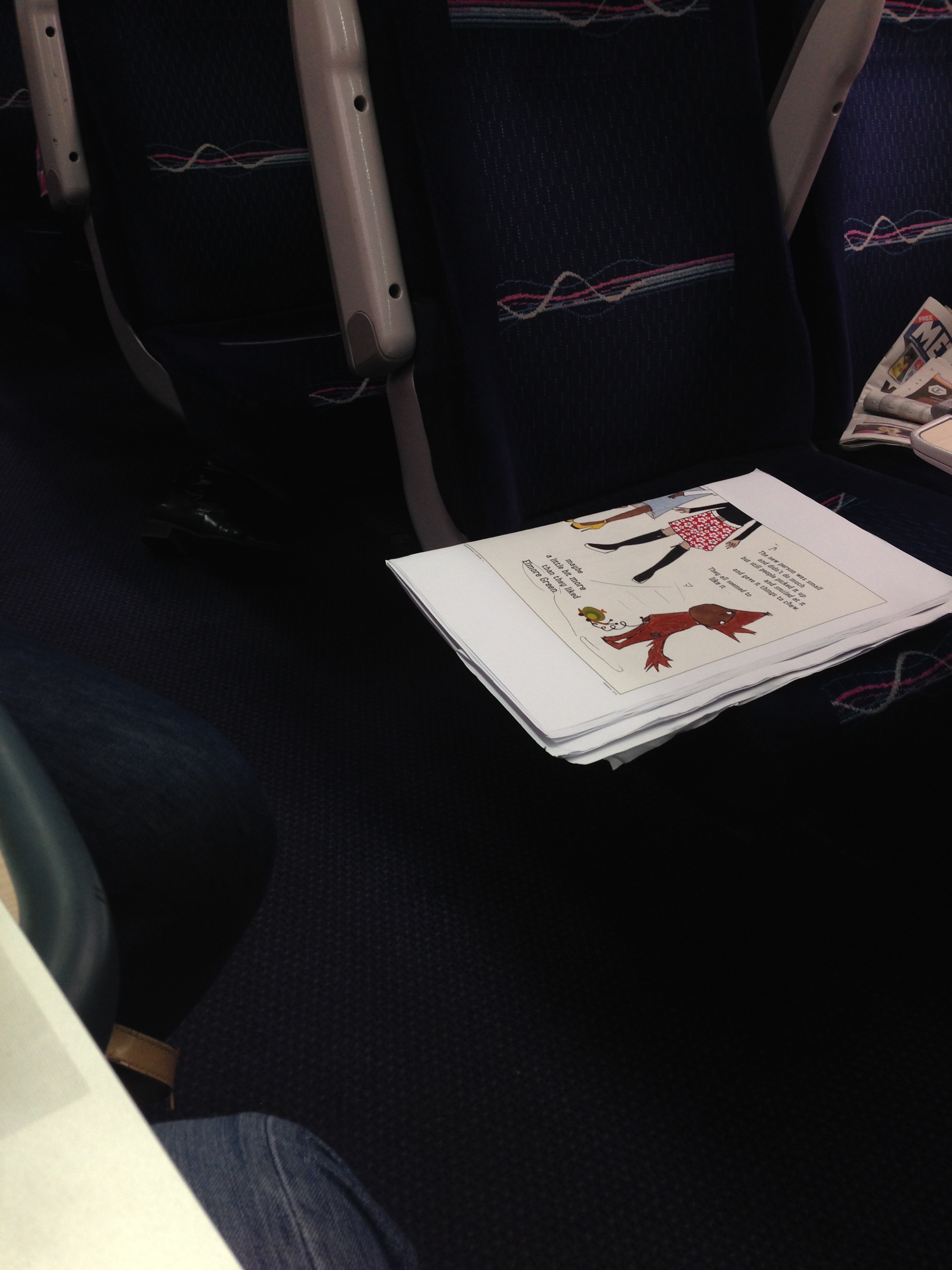
My most recent example was just last week, sitting opposite a woman who was working on her laptop and referring to a sheaf of A3 colourful papers. They had the unmistakable artwork of Lauren Child, a children’s author and illustrator. As a father of a ten year old and an eight year I recognised the artwork and style immediately as the author of Charlie and Lola, some of my children’s favourite story characters. The papers in questions had plenty of hand drawn mark up on them suggesting this was in the final stages of editing and layout prior to printing, the story itself centering around one Elmore Green who was jealous at the arrival of a younger sibling into his family. It all ends well of course, with Elmore having someone to snuggle with at the end of  the book.

Three things surprised me. Firstly, the way in which the papers in question were left out of the direct sight of the woman concerned, either on a seat on the opposite side of the walkway, or even underneath her own seat (and very accessible from behind). Secondly I was able to discern a large amount of detail from the book in a very short period of time; this is of course partly down to the nature of the book itself, but also, because each page was carefully moved to in turn and then placed somewhere I could review it and even photograph it. Finally, I was alarmed that someone like Lauren Child, who has a very unique and successful place in children’s literature would allow an as yet unpublished book be revealed in public in such a way as this.

Fingers crossed for Elmore Green!

Fingers crossed for Elmore Green!

This is of course very serious for Lauren Child and her publishers; why was this person allowed to take large copies of this book into a public space? If they knew it needed to be worked on in a train or other public space why weren’t electronic versions made available? Or had they even considered the fact that someone could have easily stolen the manuscript and copied it for an earlier release to capture their particular market?

The implications for UK PLC are probably not that great, and yet examples like this are played out across the country whenever people travel and feel they are in ‘safe‘ environments, with a dangerous cumulative effect for the country. The combined effect of actions like this could potentially add up to the millions in lost opportunities and lost work.  It reminded me of Wendy Nather’s response to a question about public apathy to security, and her surprising yet eerily accurate response was;

I don’t think that society in general will stand up and do something about security until people start dying in enough numbers that it could happen to them individually and not just organizations because we don’t care about organizations.

I sincerely hope Lauren Child has not been hurt by this incident financially or otherwise, she has given too much joy to my children to wish that; but if she reads this I do hope she feels sufficiently motivated to insist on stronger controls around the management of her manuscripts from her publishers.  If you would like some help doing that Lauren, feel free to contact me!


If It is Too Good To Be True, It Probably Is – Cross Post

(Originally Posted on Information Security Buzz on 15 January 2014)

There are plenty of tips on the internet that give great advice on how to avoid phishing scams, and there will be other authors on this site that will be giving very similar advice. For me though, it always comes down to the following three thoughts that I keep in mind whenever I see an email that could possible lead to a scam.

1. Is it too good to be true?

Infosecurity-Buzz-January-2014.002.jpg.001-300x168If the email in question is offering me something for nothing, especially if there is money, or a monetary value involved, this type of email falls into the “too good to be true” category. I have yet to come across an example of when someone really was giving away iPad’s, cash or holidays without some kind of quid pro quo involved. If your answer to the above question even looks like it might be a “yes”, the email and its contents can probably be ignored.

2. Don’t Click it!

Infosecurity-Buzz-January-2014.002.jpg.002-300x168I have borrowed this particular phrase from Jaded Security who coined it a few years ago, and I like it because to be honest it is simple and memorable advice. There are nuances to this of course, but unless you are experienced just don’t click links in your email (see number three). As you get used to looking out for this kind of email there will of course be other telltales that will help you know if an email is genuine or not. For instance, is the email from a close friend, but they haven’t addressed you by your nickname, and seem to be oddly formal, or have more spelling mistakes (or even not enough) in their message? It could be that they have been compromised and you are in their address book and therefore being targeted.

Some people regularly send links in emails, others almost never; if that’s the case, ask yourself why they have suddenly started today seining you a link to a sneezing panda clip.

Finally, if your bank sends you a link to change your password because of system upgrades, don’t click the link they send, but go to your usual bookmark for them. Your bank should never do this anyway, but clicking on a link in an email like this is almost guaranteed to not send you to your bank, but a very convincing fake site set up to harvest your usernames and passwords. Just don’t click it.

3. Fail Safe

Infosecurity-Buzz-January-2014.002.jpg.003-300x168It is always better to mistake a genuine email for a scam rather than the other way around. The consequences of clicking something are very serious whereas the consequences of not clicking on the attached link are rarely, if ever, serious. Additionally, if it is a genuine request, the sender is likely to send a reminder or contact you through another medium such as SMS, letter or telephone. Of course there are plenty of scams through these mediums too (another topic perhaps?), but you will have the balance of probabilities on your side, and the knowledge you haven’t done anything stupid.


Cross Post – The Human Element

(Originally posted on the Iron Mountain Information Advantage Blog, November 20 2013.)

lost-keys1Leaving things on the train or in a restaurant, or in fact anywhere is an unpleasant fact of life for many of us. I would guess that almost all the readers of this blog have at some point left their keys, wallet, shopping, hat, gloves, children, scarf or phone somewhere or other. On occasion, such lapses in concentration can be upsetting, costly, or embarrassing and in some rare instances even dangerous. But in most cases what we leave behind is either easily replaceable (gloves), insured/covered (bank cards) or worth the cost to change and replace (keys). It’s very rare that we leave and lose something irreplaceable (presumably you found the kids!). This is because the items we treasure often have significant intrinsic and/or emotional value. A good example would be family heirlooms, passed down from generation to generation; we treasure them and therefore take care to protect them, storing them in a safe (or at least a safe place) to be taken out only on special occasions.

What about leaving data somewhere? It wasn’t so long ago, that civil servants and the MOD were criticised frequently in the media for leaving highly sensitive and valuable data exposed in public places. Rarely, it seemed, did a day go by without the Daily Mail bemoaning the inability of the public sector to protect our data. Headlines called for heads to roll. And yet, invariably, these were just the kind of simple, human mistakes that every one of us have made in one way or other. These days, however, the vast majority of data is (or at least should be) encrypted, both when it is on the move and when it’s at rest. Consequently, the loss or theft of encrypted data may now raise fewer eyebrows.

Printed matter, however, is another thing entirely. You can’t encrypt paper documents, and paper is very difficult to secure during transport, without somehow physically attaching it to your person. Taking sensitive documents from one location to another, so often a necessity, quickly becomes a thing of peril. Conceptual drawings, designs, technical drawings, mock ups etc. will often need to be taken to a client site or a manufacturer, and sometimes cannot be sent electronically. After a successful pitch and a few celebratory drinks afterwards those documents could all too easily be left on the night bus to Neasden, unprotected and full of intellectual property and sensitive information. A breach like that can so easily turn a night of celebration into a morning of embarrassment and apologies, followed by the inevitable search for new clients.

Protecting printed documents is difficult, probably more difficult than electronic information, and yet we seem to put all of our efforts into the very latest and best encryption, protected USB keys, and expensive data loss prevention (DLP) initiatives. It’s easier to put in place a technology, especially a “transparent” one than it is to change behaviours.

I would suggest that the information security community needs to address this disparity; the paperless office hasn’t transpired, the digital documents are secured, but paper has been left behind. How can we address this without handcuffing briefcases to people? As usual, it has to come down to awareness, we need to drive home the message that paper should be transported with the same care as electronic records, observing sensible procedures such as ensuring there are always two people present when travelling with paper (to act as more of a reminder than as a physical protection) or even only couriering them with a specially selected and reviewed vendor.

I don’t want to turn the Chief Information and Security Officer into a George Smiley type character, but I do want all of our sensitive records to be treated with the same level of protection irrespective of format.


Why I am an Analogies Project contributor

Bruce_Hallas-300x286That devilishly handsome bloke you see to the right is Bruce Hallas. I used to go to school with him nearly 25 years ago, and then last summer, at the first old boys school reunion that our year organised since leaving I met him again, and it turns out we are in the same infosec business. I spoke to him about all of the good work I am doing, the company I work for, the many countries I visited and generally tried to make myself feel more important than the skinny eighteen year old I was when I last saw him. He told me that he runs his own infosec consultancy, his own blog, works with the UK government, and was in the process of setting up “a project” as a freely available, self funding, resource of analogies/stories to help people better understand information security. (Bruce immediately won the “my life is awesome since leaving school” competition of course.)

Since that time, The Analogies Project has grown from one man, an idea and a website to something producing real, quality content, and with a very promising and bright future.

In the words of the Project itself;

The Analogies Project has a clear mission. To tackle the unintelligibility of information security head on and secure the engagement of a much broader audience. Its aim is to bridge the chasm between the users, stakeholders and beneficiaries of information security and those responsible for delivering it.

Through a series of innovative initiatives the Analogies Project will enable information security professionals to effectively communicate with their chosen audiences. The content will be delivered through a variety of alternative communication techniques, media and partners.

The part of this project that I like the most is that it is essentially a community project. Bruce isn’t charging money for membership to the analogies as they are written (and they are coming thick and fast now!), and none of the contributors are charging for their work either. There are not only the web contributions in the form of a library, but a book planned, a conference, and even an opera! With the momentum that is currently behind the project at the moment there is every reason to believe in its future success.

So why am I contributing? Honestly, I have selfish and philanthropic reasons to do so. Obviously it gets my name out there, allows me to practise my writing, test some ideas and also say “I was there from the start”. All that aside though, I have frequently struggled in my day job to get infosec concepts across to people, either directly, in meetings or even in awareness training. To have had a resource like this available to me five years ago would have made my life so much easier, allowed me to advance the infosec “cause” more effectively and given me a set of tools I knew were consistant with the prevailing thoughts of industry commentators. Having a centralised, peer validated, toolkit available is fundamental to us as professionals when it comes to the messaging we give to our users, clients, bosses, teams and even the infosec community as a whole.

It’s still early days, but I have submitted my first contribution just last week (soon to be published I hope) and I am already inspired enough to be working on my second and third. There are a number of analogies already in place, and I would urge you to read them and consider them in the context of your current communications to your audiences, whomever they may be.  The book will be another important milestone and one I hope to play a part in; indeed I hope to be able to play a part in the the project for the forseeable future, and why I am happy and proud to display my “contributor” badge up on the top right of this site.

TAP-Contributor-Semi-Transparent-250x160

If you feel you have something to contribute, then head over to The Analogies Project and let Bruce and the organisers know. If you don’t feel ready to, then certainly check it out anyway. You won’t regret it.


We turned around, and there he was… gone!

This is a picture taken in Starbucks, just a few minutes ago. Can you guess what’s missing?
Why the owner felt it was a good idea to go to the toilet (while carefully taking his iPhone with him, because otherwise it might get stolen!), leaving his laptop in a busy room where it could be easily removed is beyond me. It was made worse because when I peeked around the screen, it was also not screen locked.
With so much noise and argument going around the infosec community at the moment around security awareness the lazy conclusion would be that all users are idiots and need their hand holding all the time before they hurt themselves with their private data. Of course it is never that simple but it is no less infuriating to see this kind of attitude in practise. Where do we go from here in trying to avoid these situations?
I have a colleague who likes to highlight that we should consider our laptops and tablets and other various devices as “bathroom buddies”. I didn’t like this term at first (my knee-jerk reaction against the American use of the term bathroom), but it really does make sense. When in a public place such as a cafe, train etc and you need the toilet or a break, take your equipment with you! It is a simple alliterated phrase that sticks in the mind, makes you smile and therefore might actually make someone change their behaviour.
On the subject of humour, there was an XKCD cartoon very recently that summed this up perfectly.
The point is that this individual who left himself logged in could have had untold damage done to his personal and professional reputation if I was so inclined. Facebook posts, Tweets, work emails, Amazon orders etc could all potentially have caused him grief. Sure, after the fact he could probably “tidy up” the mess, but why put yourself in this position?
In the security awareness debates, system design is often touted as the way ahead, and in actual fact I think this may have come to the aid of our hapless coffee drinker, if he was lucky. The laptop itself looks like a new MacBook Pro, possible a Retina given the new style charger. That would mean he would be running Lion or Mountain Lion, which means FileVault is installed, although not enabled by default. If it was enabled and I ran out of the cafe with his laptop chances are when I sat down at the nearest park bench to check my prize the laptop would have locked and required a password. There is a good chance there that his data would be secure and encrypted. The same would be true if it was a Windows 7 or 8 laptop. The problem here though is that the key phrase above is “not enabled by default”. It’s great these operating systems now come with encryption built in, but there aren’t even annoying prompts a la Microsoft that, for instance, I don’t have an anti virus program installed; it is left entirely to the user to be educated and security savvy enough to enable it. I have joked on this blog before that encryption today is at the same level of anti virus of twenty years ago (Dr Solomon’s anyone?). Today, I would wager virtually everyone knows about anti-virus, and in fact it is often bundled and enabled by default on new laptops. (I am not going to take this opportunity to talk about the efficacy of anti virus as an endpoint protector!). When will encryption become such a commodity that you are an oddity if you don’t have it?
This isn’t a particularly racy topic, but it is one that is played out every day in cafes around the world. As every teacher will tell you, when you get the fundamentals right, the rest will follow far more easily. This person really should have known better, but when will we be at a point that he wouldn’t have had to?