Video: Playing the Game of Thrones at RSA Europe 2013

I’m no HBO, but I am pleased to say I have just posted a video of my talk at RSA onto YouTube, entitled “Playing the Game of Thrones; Ensuring the CISO’s Role at the King’s Table. Recorded by my good friend and evil twin brother Kai Roer (@kairoer) it is the session in its entirety along with pertinent slides throughout.

I was pleased with my personal performance at the time, but of course watching it I see many areas I could improve upon. (I am planting my feet better, but still by no means do I stand still for instance.) The staging of the room was very poor, but unfortunately there was not a lot that could be done about that, and many other speakers had to put up with the same issues.

The full abstract for the talk (from the initial submission) is:

Why is is the CISO constantly frsutrated with being required to report to areas of the business that either don’t understand it or conflict with so many of the core deliverables of the role? Too often it is beholden to the agenda of the technology focussed CIO or blinkered by the financial constraints of the CFO. How has the role even got to this place?

Starting with a brief historical look at where the CISO role was borne from in the first place, progression to this current state of affairs is shown to be inevitable.  What is needed is a plan to disrupt this status quo and ensure a CISO is in a position to not only understand the power of the business intelligence that is produced in a well managed environment, but how to ensure it reaches the board in a way that is understood.

Through the use of a universally understood information security model, the CIA triangle, the presentation explores three key areas to assure the success of the CISO in being asked to report to the board rather than being summoned to it.

Initially the actual source of the information, its gathering, the methods employed and the common pitfalls often seen are explored and clarified. What are the common mistakes, how are they rectified and how can you recognise when the data gathering programme is going awry?

Secondly, how is it being pulled together, and what is it saying? How to understand the audience it is being presented to and what can be done to improve its chances of being understood.

Finally, how does the CISO make the final push for the board? What are the key principles that need to be understood about supporting a successful business, what home truths about the information security industry are rarely mentioned and how can the CISO differentiate themselves from those that came before?

This presentation seeks to broaden a CISO’s skills beyond the technical and the post nominal focussed industry accepted norms and into those that actually help a business do what it does best.

The content from this and my other recent talks will start to appear on this blog as I put my ideas down more into the written word rather than a presentation format. I have just one more speaking engagement before the end of the year now, and one in the first two weeks of the new year, so I hope to find more time to write rather than created decks.

I hope you enjoy the video, and as always I would greatly appreciate your feedback both positive and negative/constructive.
Amsterdam has them now: RSA Europe 2013 and playing the Game of Thrones

IMG_2991As usual it was a great week at RSA Europe, as much for the hallways track as all the other tracks on offer. Whilst it may not be as large as it’s bigger brother in San Francisco the move to Amsterdam from London seems to have given the conference a new sense of purpose and scale. The potential to grow in this location is obvious. But I hope it doesn’t grow too much more; there was always a sense of knowing what was going on and when, and where you were in relation to the auditoriums and speakers. I am sure that sense of perspective is more than lost in the scale of RSA San Francisco.

It still had it’s challenges, all minor. For instance, tea and coffee points that seemed perpetually shut throughout the day, a distinct lack of activities on Wednesday even after a 17:00hrs close, and perhaps the location did not lend itself to the kind of out of hours socialising that London had to offer. For me the Novotel bar became the centre of my networking experience, no bad thing, but I would wager there were a few more hotel bars doing the same thing meaning the networking was seriously fragmented.

The usual suspects were there for me to socialise with as well as some new faces, such as Tor and Kjetil from Norway who were both intelligent and hilarious, a combination I always enjoy. I managed to meet a few more of our industry “luminaries” as well which is always interesting (never meet your heroes!), as well as catch up with others I had met previously and enjoyed their company and insights.

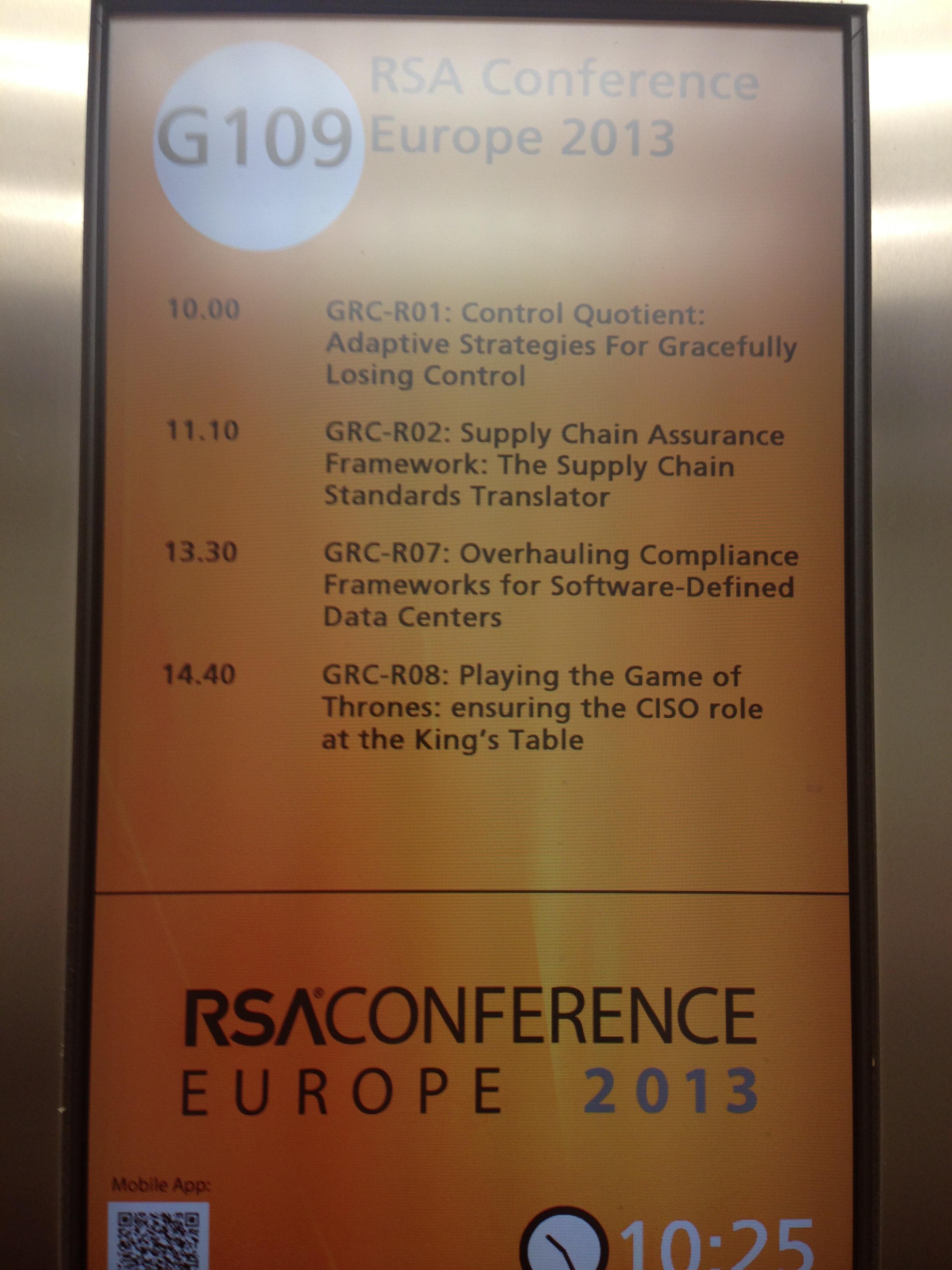
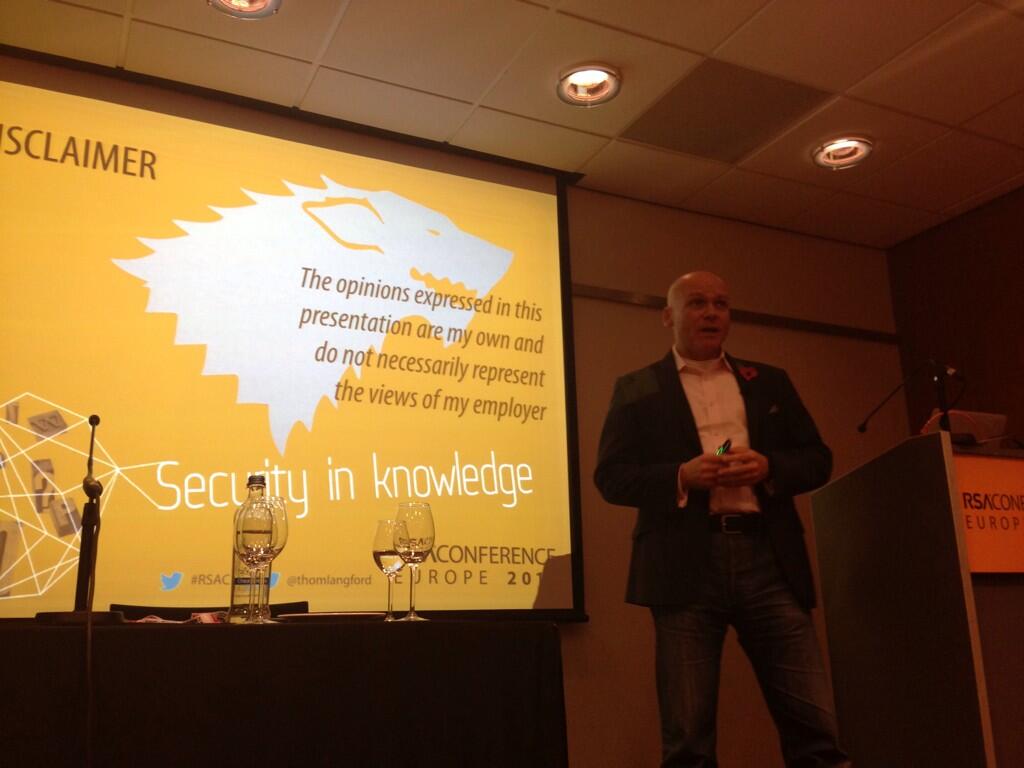
IMG_2998For me the whole conference was focused upon 14:40hrs on the Thursday when I presented “Playing the Game of Thrones: Ensuring the CISO’s Role at the King’s Table”. Not only was I presenting in my own right but I was also presenting content and an approach that I had synthesised from a variety of sources and my previous thoughts and theories. The session went extremely well, was watched by a number of people I know and respect, and was fully attended (with even a couple of people having to stand). Questions at the end were thin on the ground although I had noticed that throughout the conference, but the feedback has been phenomenal. I haven’t had the formal feedback from RSA yet, but their newly introduced conference app allows me to see a certain degree of feedback on both me as a speaker as well as the talk itself.

RSAC Europe 2013 GRC-R08 THOM LANGFORD.005

The slides are above in PDF format, and are also available in Keynote format here. My good friend and evil twin brother Kai Roer kindly filmed the talk as well, and as soon as that is available I will be publishing that on YouTube. One of the key reasons for doing so is to invite more comments on the material itself, as I made a few bold statements that I am sure not everyone would agree with. For instance, the less influence a CISO has, the more prescriptive (and lengthy) the policies are, in turn making them less effectives. This is based on my observations only rather than research, so getting feedback on points such as this helps inform everybody more.

All in all it was a great week, making new friends and meeting old ones and always learning new things almost every hour. Here is my honour roll of folks from the week that made it as memorable as always:

Javvad, Brian, Kai, Kjetil, Tor, David, Dave, Bruce, Tor, John, Dwayne, Quentyn, Neira, Josh, Martin, David & Olivier (my apologies to anyone I left out, it is the fault of my memory and not how memorable your were!).


Don’t Put Baby in the Corner

5670_fullLast week I had the opportunity to do both a presentation at the BCS IRMA Specialist Group as well as take part in a drastically reduced panel with Javvad Malik (and only Javvad!) at the InfoSec Europe 2013 Press conference.

Firstly I want to recount the panel for the press conference. After some last minute drop outs (one of which I was replacing anyway!) there was just Javvad and me available to do it less than 24 hours before we were due to start. In his own inimitable style he proposed a double act Parkinson style to talk about the challenges faced by a CISO in the Enterprise. I was somewhat unconvinced by this but true to his word, the whole session went extremely well and was thoroughly enjoyable. Afterwards Javvad was told  by some of the journalists that the session was a great way to end the two days with the non vendor focus of the session, and the humour that Javvad and I of course used!

One of the main topics we discussed was that of the position of the CISO within the organisation and the influence that this subsequently brings. Ultimately my position is clear on this, that the CISO needs to be as high in the organisation, and as independent of vertical alignment as possible. What I mean by this is that if the CISO is on the board (or executive leadership team as appropriate) and does not report into the CFO, COO, CIO or any other C level executive there is a dramatically increased chance of security being a successfully managed activity in the enterprise. It ensures full representation of the security function at the most senior levels, free of conflicts of interest and able to vie for budget and attention on an equal footing with the rest of the business units.

I will caveat this however. If there is no security function in place or it is in its nascent stages, or the business itself is smaller, it makes absolute sense to have the security function perhaps initially reporting into the CIO; in all likelihood the staff building the team will come from IT anyway. However, as the team grows it needs to evolve its leadership and position in the organisation, perhaps moving away from the IT function, to the COO and then ultimately to the board.

This transition is something that I have never seen planned in advance, and this is probably one of the fundamental reasons why the CISO and security function is constantly under represented in the modern enterprise as it struggles to gain independence. This will always result in poor awareness and training, lack of budget and lack of true top down security adoption as they compete for ever diminishing resources from lower down in the organisation.

One fairly unique place I have seen the security function is reporting into the General Counsel/Legal function. This I have seen work well as it is the GC that is traditionally responsible for the tracking and management of risks for the enterprise, and frequently has the ear of the CEO. I rarely see a conflict of interest with the security function either. This is not common though, and is likely to only be likely in the larger organisations that have a formal role of GC.

Bottom line, if the newly appointed CISO (i.e. a senior level position for a mature security team) reports into the CIO, then in reality, security is not going to function effectively in that organisation.

And finally (although not in chronological order), the BCS. It was the final presentation of “An Anatomy of a Risk Assessment” and it was (as far as I can tell) well received. Unfortunately the weather and lack of sandwiches post the even meant there was little time to mingle afterwards, but I have since received a number of favourable comments and of course connection requests on LinkedIn which is always heartening. I did however  feel I didn’t answer one of the questions at the end, about India, particularly well, and may have come across as a little disingenuous when nothing could be further from the truth. I hope my friends and colleagues from india will forgive me if they make it to the end of the video when I get hold of a copy (and post it here). As an aside I found an extremely flattering write up of the very first time I presented this in January last year. To the author at Acumin, thank you! http://acumin.wordpress.com/2012/02/

All in all, a very enjoyable and engaging kick off to 2013.