Style vs Content – Getting the Point Across Effectively

I have just had to present to a team on their information security responsibilities whilst they are on their current project. Their client has very specific requirements, and for a variety of reasons it was important to reinforce the key requirements again.

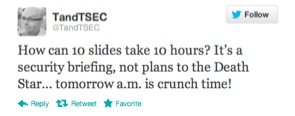
This was at short notice, and so I spent every spare moment I had throughout a long day last Thursday creating the presentation from scratch. After reviewing Master Services agreements, security schedules and other documents relating to the project I had to try and consolidate all of this into a meaningful presentation. I even Tweeted about my experience:
This is a battle hardened and very creatively talented team, working stupid hours and closing in on an important milestone of work. The last thing they wanted was to listen to the “corporate security guy” for twenty minutes, but for all the right reasons it was important that it was done today, and with the client present.

So I had: 1 – a disengaged audience, 2 – 24hrs notice, 3 – a client present, 4 – strong interest from HQ (“send us the presentation when you finish it so we can check it through” and finally, 5 – changes to be incorporated two hours beforehand (see 4).

Pop Quiz – do you use the corporate deck, smart and extensive bullet points, approved imagery and and a shirt and tie? Or do you focus on getting key message across, come what may?

And this is the crux of my point – the moment you try and deliver a corporate message in a corporate format your audience is going to switch off. One suggestion I received from a well meaning executive was to basically provide a list of the twenty requirements of the client in the presentation and then hand out copies to be signed by each team member. In this instance people would remember the first two, last two (at best!) and just blindly sign the rest. While this would technically meet the objectives (everyone must agree they understand the security requirements) they really wouldn’t absorb the message.

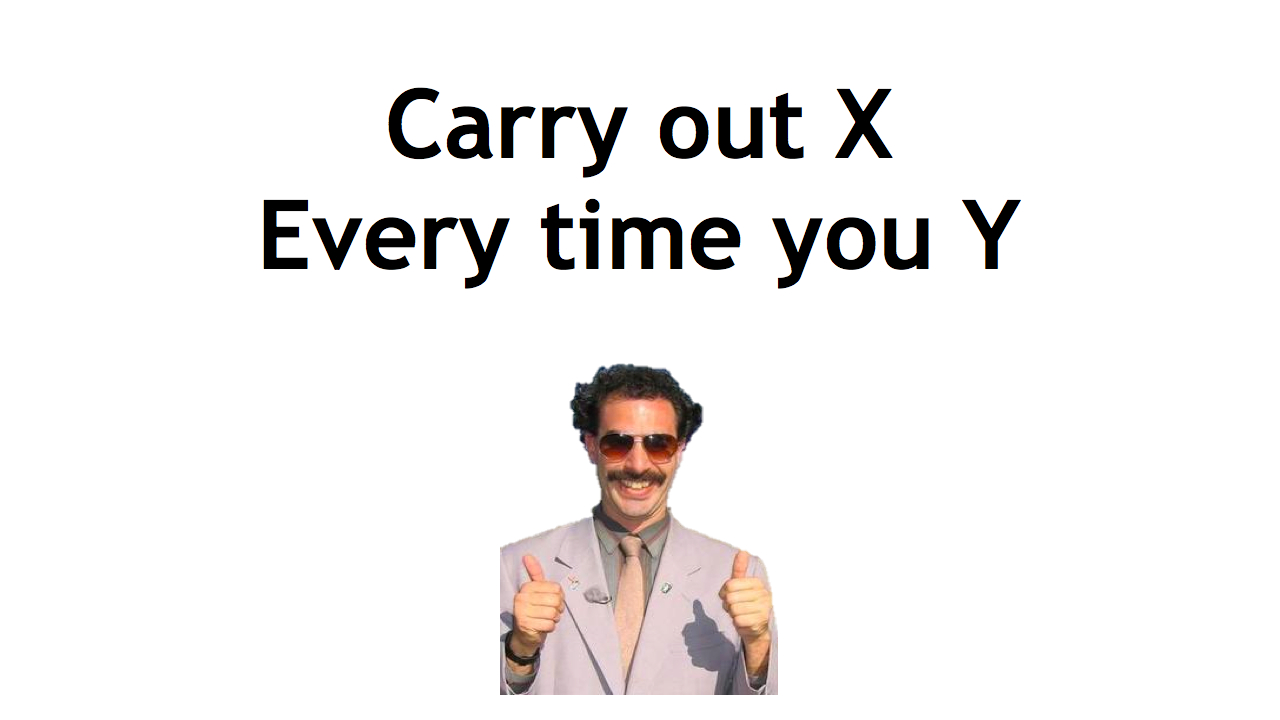
My approach? Simple, high impact and memorable. As the example below shows, not many words and a memorable picture (in the actual presentation Borat merged to Simon Cowell showing a thumbs down and back and forth). In this way, the image hits them first (thumbs up/thumbs down), the message (check X when doing Y), and that’s it! (The message has obviously been sanitised to protect the innocent).
 Of course, there were many other slides along this nature – I also used references to The Oatmeal, Dilbert and Defcon 18 amongst others. And each slide put across a very specific point.

At first glance, the deck looks awful, plain and badly designed. However, the simplicity of it ensures the message very clearly comes across with the imagery ensuring that message remains memorable.

Three things came across very strongly at the end. Firstly, the questions and comments at the end were engaging, sensible and eminently relevant. This made me very confident that the message was put across and understood, and that this approach was the correct one in this circumstance.

Secondly, the client saw this engagement, and has since requested a copy of the presentation to demonstrate how the team had been successfully “trained” and and updated on security practices.

Finally, in front of this creative audience it became crushingly obvious that I really have to up my game when it comes to clip art…


BSidesLondon – Woot Woot!

What a marvellous couple of days I have just had; Tuesday at InfoSec Europe in Earls Court followed by BSidesLondon in The Barbican on Wednesday. While InfoSec was good, and I enjoyed not only the wide variety of stands, prizes, swag and educational events, it is and will always be a trade show. I always feel I am one tiny eye contact away from signing up to 1000 licenses of a product I never knew I need.

BsidesLondon however was an entirely different event. This was the first BSides event I have attended anywhere, and its reputation as an edgier, grittier and slightly geekier type of conference (or at least that is what I picked up on) was entirely unjustified. What I experienced was an extremely high quality of talks, great organisation, interesting activities, engaging workshops and above all a broad, eclectic mix of information security professionals. To be honest, I was somewhat concerned that my professional background in governance, risk and compliance was going to be entirely misaligned, but I was encouraged to attend by a colleague in our Boston office. How mistaken I was!

I should have guessed really when a talk I submitted was voted for by the attendees (An Anatomy of a Risk Assessment) – I explicitly stated it wasn’t technical, or even focussed on a given standard, but rather a more social/human experience of risk assessments. Whilst I didn’t exactly fill the auditorium to the gunwales, I estimate there were about seventy people attending. I also had some great questions at the end and a stream of conversations and compliments throughout the rest of the day. I even managed a few more Twitter followers!

(On that last point, I think I really am going to have to pull my finger out now and start providing some real value on Twitter, and especially this blog!)

The “Crew”, and team of people entirely made up of volunteers who gave up their full day to support the event (and miss out on all of the great activities as well) did a phenomenal job in both setting it up and managing it. I was able to thank a few of them in the bar at the after party, but I know I missed a few; to all of you, Thank You!

If pushed to, there would be a few things I would change; please understand this is by no means a criticism of any aspect of this years event, but rather a desire to see a cycle of continual improvement!

1. Make it a two day event. I would hope this would encourage more volunteers who could do a half day stint at a time. This would mean that volunteers would not miss out on the excellent content. (I heard many times “I haven’t been able to see a single talk all day”)

2. Charge a nominal fee. By nominal I mean £50 for two days (£25 for students/concessions etc of course. That is only a night or two of beer for an average student and they will more than make up for it at the after parties!). This would ensure people actually turn up – I saw a lot of unclaimed name badges at the reception which is a massive shame given the clamour for tickets. One day tickets could be suitable priced at £30 and £15. This would also take the pressure of the organisers for the basics like T Shirts, lunch, booking fees etc and the (excellent) sponsors can focus on the value-add stuff.

3. Increase the numbers. I know smaller events have a niche value and connect with the community more effectively, but I think a third track formal could easily be accommodated next year as the reputation of this event will only improve and numbers wanting to attend will increase. There is a balance to be had, but pushing to 500 or 600 is still viable in my humble opinion.

All that said, even if everything stayed the same I will still be attending next year, and hopefully speaking again. Congratulations to all involved, what an amazing event. It’s barely been two days and I am already looking forward to next years!