Not All Risks Are Bad (even the bad ones…)

Keep_Calm_Big_ThinkThe very term ‘risk” often makes people feel uncomfortable, with connotations of bad things happening and that if risk is not minimized or removed then life (or business) becomes too dangerous to continue.

Crossing the road is risky, especially if you live in a busy city, and yet people, young and old alike, do it every day. In fact it is riskier than flying  and yet I would argue that there are more people afraid of flying that of crossing the road. Hugh Thompson of RSA put it very well in his 2011 RSA Conference Europe presentation when he raised the issue of “Sharkmageddon”; more people are killed every year sitting on the beach by falling coconuts than those by sharks, but there is an almost universal fear of sharks. We irrationally consider swimming in the sea safer (less risky?) than sitting under a coconut tree.

Risk is an inherent part of our lives, and if we let the realities of risk take control of our business decisions we become the corporate version of an agoraphobic; staying in the safe confines of the environment  we know and not ever venturing out to be active in the outside world; ultimately we wither and fail be it as individuals or as a business.
In my experience, one of the most misunderstood approaches to treating a risk is to accept or manage it. Most people are comfortable with mitigating, transferring or avoiding a risk as they involve some kind of act to deal with them, something we are all familiar with. We fix a problem, give the problem to someone else or stop doing the thing that causes us the problem in the first place. However, it often feels wrong to simply accept a risk, in essence to do nothing. Although this is not strictly the case, it is essentially how we feel we are dealing with it. You are accepting that there is either nothing you can do, or nothing you are willing to do to reduce the risk. However, you are not blindly accepting it at face value; rather you are being cognisant of the risk as you continue your operational activities. You know it is there as you carry on your day job. These activities and the very environment you are operating in can change without notice, and make the decision to accept a risk now the wrong course of action.

For instance, it may now be cheaper to fix the risk than it was going to cost you, or the highly lucrative contract that made the risk acceptable is now over and there is a greater risk of financial lost that costs more than the revenue you are bringing in. The reasons for change are often financial, although not always. Your risk appetite may also have reduced or the industry you are operating in becomes more regulated; all of these example mean your decision to accept needs to be reviewed.

All risk decisions need to be reviewed regularly, for exactly the reasons given above, but in my opinion it is risk acceptance decisions that should be reviewed more often, as they are the ones that are made as a result of more transient and changing factors, and are the ones that will potentially harm the organisation the greatest.

tiger__extIt’s a bit like keeping a tiger as a pet – it looks awesome and maybe even draws admiring glances from many, but if you forget you locked it into your bathroom overnight you are going to have a very big surprise when you get up to go to the toilet in the middle of the night. You can’t accept risks without truly understanding them in the first place.


An Approach to Risk Decision Making – a Review

Public expenditure

I decided to write a review of a paper submitted to wired.com on the subject of “An Approach to Risk Decision Making” by Curt Dalton. I must however declare an interest in this, in that I happen to report to Curt in my day job (he is global CISO), and that he was kind enough to share drafts with me as he wrote it for feedback. This will of course therefore be a somewhat biased review, although not too much, but I do hope if nothing else it generates conversation around topics and approaches like this. I have a huge respect for Curt, have learnt much from him over the last few years and hope to get a good score in the next performance review!

In essence, this model is designed to help an orgnaisation decide if it is financially viable to invest in security technology/controls/procedures in order to address a given risk. It is not designed to be used across an organisations risk management porogramme, but rather with those handful of risks that can’t be addressed in day to day operations and have to be escalated to senior management to be effectively resolved.  With limited budget and access to that senior leadership, this approach provides support and guidance on what to ‘fix’ and what not to fix.

This scope is a key element of the model; it uses very traditional approaches to monetizing risk versus the more in vogue approach I have reviewed elsewhere in this blog. To that end it uses assigned numerical values to elements of its calculations; this is of course where ‘errors’ may creep in, but in theory an experienced risk manager familiar with their environment should be able to assess this reasonably well.

In summary, the model is as follows:

Figure1_660

Figure 2 in the model requires an analysis of controls required to address a risk.

Figure2_660

This does of course beg the question, how do you know you have all of the controls required and how do you know you have selected the correct numerical value? Again, the pragmatist in me suggests this is entirely possible with someone who is familiar with the environment and the organisation, but this may of course be more difficult in other situations.

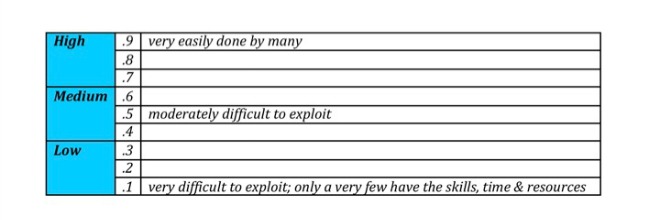
Figure 3 does a similar thing with a similar level of granularity, i.e. defining in nine increments the ease of exploitation of a given risk; where I think there is potentially something missing is that this value applies to ALL of the risks listed in figure 2 rather than individually.

Figure3_660

Obviously this would massively increase the complexity of the solution but this is a deliberate approach to ensure simplicity across the model.

These two numbers are then combined with a simple calculation of impact to etsablish a level of monetized risk. Finally, the 80/20 rule (or Pareto’s Principal) is used as a rule of thunmb to define the actual budget that should be spent to mitigate a risk. In the example given therefore a monetized risk of roughly $1.5m USD should be mitigated by spending up to $380k USD and no more. The Pareto Principal can of course be adjusted accoring to your organisations risk appetite, that is, the more risk averse the organisation the more the rule would move from 80/20 to 70/30 or 60/40 etc..

There are a lot of assumptions used in this model, not least the numerical values that may seem to be arbitrarily assigned. However, I believe this can be forgiven for the very simple reason that this is a pragmatic, transparent and easily understood approach; it can be easily transferred into an Excel spreadsheet meaning that some simple modelling can be carried out. I have said before that until the newer approach to risk management has a more easily understood and implentable approach it will not be adopted. This model does.

The other part to this model that I like is that it is not designed to be a cure all, but rather a tool to help organisations decide where to spend money. If the approach is understood then an informed decision can be made within the constraints of that model (or indeed any other model). I believe it is influenced by the ISO27005 approach to risk management which means many risk management folks will be able to grasp and adopt it more easily.

Overall, this is a model that can be adopted quickly and easily by many organisations, and implemented successfully, as long as its basis in assigning numerical values is understood, and calculations are carried out by those in a position to understand their risk profile well. I would strongly recommend you tai a look at the model yourself over at Wired Innovation Insights.

Pros – easily understand, pragmatic, focussed on one business issue, easily implemented.

Cons – relies on assigning ‘arbitrary’ numerical values, doesn’t address granularity of risk and ease of exploiutation.


Why the Feds will still be attending DefCon

not_a_cia_undercover_agent_tee_shirt-r9461211bf55a482f9a192e013ac3584c_804gs_216This is not a the type of post you normally get from me but I felt compelled to jump out of my comfort zone given the amount of coverage that DefCon is getting as a result of banning “Feds” from attending DefCon 21 this year.

My personal opinion on this is somewhat irrelevant given DefCon is not the type of conference I attend given the core topics covered are not my day job. For what it is worth however I am a staunch believer in having as open and transparent a dialogue between two opposing viewpoints as possible, and therefore feel this is an odd and somewhat self defeating decision.

But perhaps more importantly I feel there is something of a naiveté surrounding the fact that 1) people think the message will be taken seriously by the Feds, and 2) that the Feds have not successfully been undercover there anyway.

I know that the “Spot the Fed” fun that occurs every year is seen as proof that the general community of attendees is able to spot the government moles that attend. I find this preposterous though! Whatever department of “Fed” it is that attends, be it the NSA, FBI, CIA or other TLA agency I think it is germane to appreciate that these are a group of people who successfully infiltrate  organisations far more dangerous than DefCon, and for far longer periods. Undercover operations are taken extremely seriously, require extraordinary amounts of character and commitment, and are not easily undermined. I am sure someone with the power of Google will be able to find the odd example of undercover operations that have gone awry, but to my mind, there are likely to be more Feds at DefCon than anyone would think, and there have been for years.

I am not going to go into what the motives for doing this are, that is for people far more politically minded than me. I would however suggest that this years Spot the Fed competition will be a dud, not because they aren’t there, but because the Feds who attend in plain sight won’t be attending. Who will you be sitting next to at DefCon this year, and how much about them do you really know?


Taking RANT to New Levels

Noise Next Door giving conferences a new twist

Noise Next Door giving conferences a new twist

For a variety of reasons I have been unable to post here as frequently as I have liked, but the great advantage of attending a conference is that it does spur one into action to get something written down. Tuesday Jun 11th saw a new kind of conference come to town, the RANT conference. Based upon the monthly RANT forum there were only three individual speakers with the rest of the sessions effectively panel debates but with significantly more audience interaction encouraged.

There were a number of highlights for me, not least all of the people I met there, new friends and old. One of the big surprises for me was the opening keynote from Mark Stevenson of the League of Pragmatic Optimists. I thought it an odd choice of speaker, a futurologist, but very much enjoyed his talk once I got over myself. he looked at (amongst many other things)  how the digital revolution is changing our lives daily. What it came down to though is that despite the massive amount of change that has gone before us, the digital revolution is merely the cocktail sausage of dinner; we cannot begin to imagine what is around the corner.

I also enjoyed watching Javvad play up to his InfoSec rockstar status alongside Neira Jones and the irrepressible Stephen Bonner. It was unfortunate that the final panellist, Ed Gibson, killed the dynamic of the panel dead, changing what should have been an upbeat and funny session into a monologue of personal dislikes that crossed the line into embarrassing.  I thought Javvad played to his RockStar persona very well, but also presented how he made his way to the level of industry notoriety he currently enjoys and the benefits it actually brings to the industry. The serious point of them actually being ambassadors for infosec was quite rightly made. Unfortunately Ed did the same for the next panel on state sponsored espionage, killing what should have been a powerful insight into the topic given his background. I understand Ed is a very highly rated speaker, but on the evidence of yesterday I won’t be rushing to see him speak, and how he handled himself was unfair on the other panellists and indeed on us as an audience.

The Boy Band Strikes back

The Boy Band Strikes back

The rest of the day went very well though, with plenty of laughs with the University Challenged pitting the grey hairs of the industry against the students of Royal Holloway, and a session on security awareness that I was invited to participate in alongside Geordie Stewart, Charles Clarke, Christian Toon and my old mate Bruce Hallas. The reaction from the audience was very positive, with some great questions and opinions. We didn’t all agree, which is exactly what needs to happen; if we all agree, nothing changes, but if there is dissent then that can finally lead to actually driving change in the industry. On the whole it was well received and moderated nicely by Jim Shields, although someone did tweet that he thought the conversation was “same old same old re training me thinks” which is actually fair enough; I do think however that we can only stop talking about it when it is “fixed” (whatever that means!).

Stephen Bonner’s presentation was a distinct improvement upon what he presented at BSides, and was a thoroughly enjoyable rant, replete with chocolate missiles for the audience.

The excellent Twist and Shout were managing the video and photography, and shared many of their corporate training videos in the breaks between sessions that not only gave a very polished and slick feel to the whole day, but also some light relief.

Networking drinks were copious and enjoyable, and the dinner was excellent with after dinner entertainment from Jim Shields in his stand up comedian alter ego and an improv comedy troupe Noise next Door. A fuzzy head this morning tells me I had perhaps a little too much fun.

It was an awesome conference overall, and I hope to see it grow and become part of the established circuit. The format can only get better as while there is a place for the traditional presentation of one person delivering content and then taking some questions has its place, there is a huge advantage to the RANT approach. It allows the audience to engage far more effectively and I would hazard a guess that the audience actually retains more than the standard 20% of content afterwards. Huge congratulations to Acumin for not only making it happen, but also for ensuring it was as free from the commercialisation of so many other vendor driven events, a hugely refreshing approach. The biggest congratulation of the day though must go to Gemma for making it happen.

photo[5]


From Paris With Love; the oncoming storm of the generational gap

frompariswithlove_1The media has been awash with stories about Paris Brown, the UK’s first youth police and crime commissioner who felt she had no option to resign even before formally taking up her post as a result of allegedly offensive messages she had posted on Twitter.

To many, she had done nothing wrong; here was a teenager who was simply testing and pushing the boundaries of her adolescent world, sharing views and comments in her private life in an attempt to learn, identify with and grow into an adult. She had been chosen from a large number of candidates for this role precisely because she was typical of many of her peers, and her views of the world and the society she lived in, warts and all, were almost a requirement of the role in the first place.

To others, she was demonstrating vulgar and offensive sensibilities in a public domain that have no place in a role in public office. To that end Kent Police are currently reviewing the tweets in question so ascertain if a case should be made against her.

I believe this is going to be the thin end of the wedge, and that many more instances of issues like this will come through over the coming  years. This is going to have, in my opinion, a number of ramifications in our industry in a number of areas:

BYOD. The adoption of smartphones across society combined with bring your own device policies across industries has meant that the boundaries between personal and professional life are becoming increasingly blurred. This blurring means that people will increasingly lose the definition between what can and can’t be shared from the workplace which is going to become an issue. Sharing confidential documents via a BYOD enabled smartphone to personal accounts so they can be worked from home is not going to be seen as an issue; the content is on “my” device after all. Tweeting or blogging about activities from the workplace is increasingly the norm, even if those activities are confidential or secret. Even the acronym NSFW, not safe for work, has evolved to identify what content may or not be suitable for viewing and sharing in the workplace (how else can I get the time to view all of this awesome content?). As quickly as NSFW has come about I predict it’s demise as these boundaries crumble and fall and anything and everything will be considered as acceptable to view at work as long as it is on “my device”.

Privacy vs Personal.  There has been a growing trend amongst recruiters to look at the social media profiles of potential candidates. There is nothing illegal or unethical in this per se, although even standard police employment checks for the kind of role Paris Brown was entering into don’t specifically call out the need for social media checks/reviews. This is the dichotomy of the situation; how can I expect privacy when I do not observe it with my company data, and yet posting my weekends antics to my friends should remain with my friends, and yet this is the very real expectation it seems. How long will it be before this crashing realisation for a generation of people that what they have done in their adolescent years as they grew up really wasn’t just between friends but between the whole world, and put them at a distinct disadvantage in the job market? And will this realisation bring a raft of legislation along the lines of age discrimination, that disallows the use of this information during interview? There have already been cases of prospective employers in the US asking for Facebook credentials of candidates in order to check their backgrounds. Whilst this does cross moral, ethical and professional lines in many of our books, this is the inevitable alternative if this legislation doesn’t come in. As an infosec industry we will be on the front line of educating people of these consequences and potentially enforcing any incoming legislation in the workplace.

Professionalism in our Industry. But what about the here and now? As a profession we are held to a high standard of professional standards and ethics. All the organisations that we affiliate ourselves with to one extent or another have clear professional ethics. If during the recruitment process you have an opportunity to review somebodies social media background, would you take it? How would you use that information, and to what extent would a checkered social life influence your decisions? There are two sides to this of course; do your professional ethics stop you from looking (or just taking action from them), but then again would you want someone who appears to display a lack of self control and publicly put themselves into position of vulnerability that may allow them to be more easily bribed or blackmailed in an area that demands high levels of security and trust?

This generational gap in appreciation of the long lasting impacts of current social media in the world of big data is an area I believe is yet to be addressed fully. The sociological impacts of a series of younger generations engaging with an always on culture of social media are not yet fully understood and should be explored further. I hope the above is dipping a toe in the water of this huge body of water. Ultimately, if you are not paying for it, you are not the customer; you are the product…

h330E1FA4