
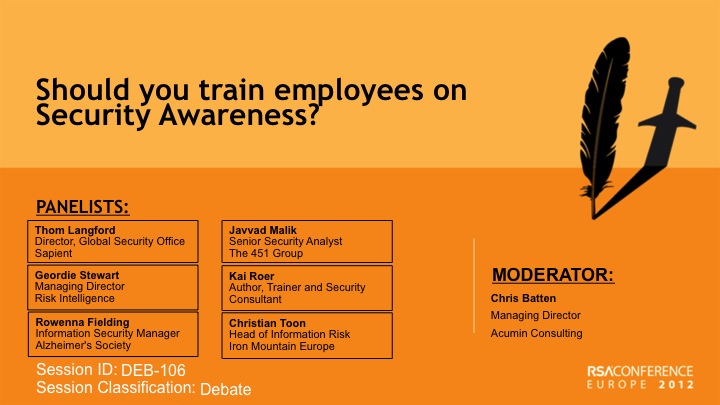
 Below are the slides, my argument and some photographs from the debate session at RSA that I was involved in alongside Acumin, Christian Toon, Geordie Stewart, Kai Roer, Rowenna Fielding and Javvad Malik. Obviously by posting it here I am only presenting one side of the argument, but if nothing else I hope to at least stir up the conversation as in reality there is no clear cut answer on this topic. The text itself was my first draft notes and attempt to build an argument; I presented it from memory on the day, so it is obviously not an exact duplicate. I felt I was in a challenging position of not only opening up the argument, but also had no one to put a rebuttal against… at least that is my excuse!
I would very much welcome your thoughts on this somewhat hot topic as well as hear about how you do things differently to ensure the effectiveness of your training programmes.
 Being asked to open a debate of this nature is probably challenging enough, but having to tell people that their information security awareness programs don’t work is a bit like telling them that they have an ugly baby; however much it may be true it is not something you can get away with saying very often before someone takes offence… or you get asked to justify yourself in a large public forum.
My colleagues will be presenting their cases far more eruditely than I am about to do so, and given what I suspect the prevailing attitudes in this room are I would therefore ask that you keep an open mind, and ask yourself the awkward questions that our arguments will pose. My arguments stem from the perspective of a poacher turned gamekeeper, so I can confidently vouch for their truthfulness from observations on both sides of the table.
So why am I against information security awareness training? Well, I think the actual term itself is outmoded, and the mechanism by which it is delivered more so. I strongly believe there are three key behaviours that stop the effectiveness of security awareness in its tracks.
Fatigue
 Ethics training, anti bribery training, how to submit expenses training, how to work the training system training and goodness knows how many other trainings, and all of these have to be done every year, and more often than not within the same few months during “compliance season”. Is it any surprise that the CBT’s are completed whilst listening to iPod’s, that the “time per slide” statistic is never more than a few seconds and that when it comes to the obligatory questions at the end the cheat sheets get handed out amongst people. People simply can’t take any more!
Do your reported security incidents really go up after your training? Because they should as people become more aware of theirs and others security practices. Or do you still continue to see the same number of malware breakouts, lost USB sticks and laptops “left on the train”, all of the stuff that was happening before. Take a closer look, and see what you can find.
Memory
 And with all of this training going on, it would take a full time job to remember it all, let alone trying to retain it in conjunction with their day job. Any kind of training that is carried out needs to be reinforced through regular practice of what has been learnt. But how often do people consciously “practice” their security skills? How often do you hear at the water cooler “I stopped a virus today!”?
Even when this training is put into supposedly professional training packages aimed at companies, they bizarrely even admit that they are not going to be fully successful; in a previous talk I referenced a company that proudly declared that their course would reduce phishing click throughs by 75%. Their course, by their own admittance is ineffective in 25% of cases.
The information security industry has a habit of streaming facts, rules, laws and requirements at people, throwing questions at them and then expecting them to put into their daily work lives. If they are lucky they might get the odd article or even get talked at by someone from IT Security rather wishing they were somewhere else. The marketing and advertising industries clocked onto this years ago, and produce smart, impactful and “sticky” bite sized pieces of information., why haven’t we?
Around, Through and Under
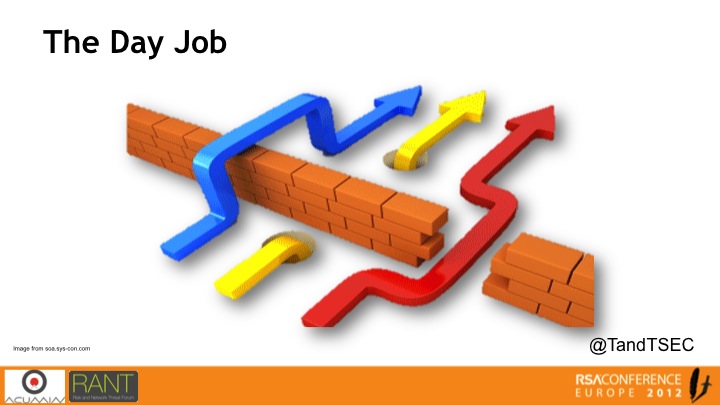 So we now have a picture of people tired of taking yet another training, can barely remember what the training was about anyway, but are also continually under pressure to get their day job done on time and on budget. With these pressures, people are going to be doing whatever it takes to get the job done.
Transferring a large data file to a client at 10 o’clock at night and the IT department have gone home? USB stick or drop box. Having to deal with hundreds of emails day in and day out? Snow blindness to clever phishing emails. Constantly changing workforce due to rapid growth (or contraction)? Let them in, they need to get their job done just like me. Printers constantly going offline because of under investment? Just keep sending that confidential print job to a different printer until it works, someone else can clear up the spare prints.
Unless their environment is stable, and helps control their actions, or asks them the questions they need to be asked to make an informed decision, people will do whatever it takes to get their job done; the consequences can, and will, be dealt with tomorrow.
In Summary
Until such a time as companies and the security training industry cotton onto this, all your thousands of pounds, dollars or rubles spent on training courses will buy you one thing and one thing only, a tick in the box of your compliance checklist. Is that enough for you, or do you want more
(Photos courtesy of David Turner)


 Thom Langford