Woof Woof, Bark Bark (or how to not support security in your organization).

security_dog_hoodie_on_black_whiteI recieved the email below from a colleague at work. At first glance it is funny, the chief security officer being represented by a dog… Hilarious! Of course security is just about being able to bark at people and occasionally bite them. This role isn’t about corporate responsibility or even enterprise risk management, it is about wagging your tail and barking at people and getting them to do things because you have barked it so.

I’m having second thoughts about my growth plan if this is where it leads to.

CSO dog

If I am honest, I am guilty of this too. I have often described myself as an “overpaid security guard” to people who haven’t a clue about information security, and they nod knowingly at me, thinking they understand InfoSec policy, enterprise risk and even DLP.

The above example of belittling the security function of an organisation has steeled me into action; if I can’t explain the role of a CISO/CSO to my Mother, then I need to re-evaluate what it is I am doing and the impact it has on the business. It also annoys me that the role of CISO is so easily belittled. I don’t think I have ever seen a CFO role boiled down to an image of a coffee bean, or even the CIO image reduced to a mouse or keyboard. What makes this worse is that this product offers “the highest security for your files in the cloud” and yet this is how seriously they take security.

A fundamental part of this is down to us as CISO’s and security people to ensure we don’t belittle ourselves to ingratiate ourselves. It is extremely difficult for us to ensure we are valued and respected in our organisations as it is, and sometimes the somewhat subservient/comedic route feels easiest. This is not the best way; it is the longest and hardest route to acceptance and understanding because the role is by it’s nature seen as a frivolity and a hilarious side act.

(We should note however that there is a place for humour in security, and if used correctly it is extremely effective. The point I am making above is that security as a serious subject should not be presented as a humourous aside.)

I recall a situation where I noticed someone working at a hot desk who had no visible identification. I asked around if anyone knew who the individual was, and nobody did. As I approached the individual I was met with a chorus of “get him Thom” and “tackle him mate!” etc. with much hilarity ensuing. None of it was meant meanly of course, but it was synonymous with the  simplistic attitude of security. If any of the people who had spoken those words had any real idea of the security implications of having someone in their office without any idea of who they are, then their response may have been a bit more serious. The best part is of course that I had plainly failed in my security education and awareness with this group of people.

We are not guard dogs. We are not security guards (although they are an important part of the security function). We are not bouncers. We are not doing security for theatrical effect.

We are here to protect your revenue, your reputation and your bonus payouts. We are here to ensure we maintain good relationships with our clients, and allow our organisations to take on greater risk and therefore reap greater reward. We are here to help inform the business of security risk and advise as required.

What’s so funny in that?

Note: I have been extremely quiet on here these last few months; my role has changed dramatically at work requiring more travel and less time for the frivolous acts of blogging. Combine that with a busy schedule with Host Unknown and my other info sec commitments I have neglected this blog site somewhat. Hopefully this post sees me back in the saddle again, and you can always catch up with me on Twitter. Oh, and the holiday was good too!

ThomLangford_2014-Aug-10

ThomLangford_2014-Aug-10 1


That was the week that was; InfoSec Europe, BSides and the Security Bloggers Network

?????????????????????????????????????????A lot of good stuff has already been written about this last week with regards to BSides London, InfoSecurity Europe and the Security Blogger awards, so this post is a personal recollection after the haze of too many late nights, early mornings and good times.

Tuesday 29th bought BSides London, and once again the volunteers surpassed themselves; it retained two tracks but definitely felt expanded with the workshops and a new location for the rookie track. The organizers should feel rightly proud of what they have done, and those of you who didn’t turn up on the day (and therefore denied others of a ticket) should take good long look at themselves in the mirror.

photo 5

The Danger Zone Dream Team

I had to spend the afternoon over at Infosecurity Europe as I was on a panel titled “One big threat to cyber security: IT Geeks can’t talk to management” alongside Dwayne Melancon and Stephen Bonner. It was only 25 minutes long but I felt we managed to push a lot of good advice and takeaways into it, and the conversations continued afterwards in the hallway. I even managed to get a reference to Kenny Loggins into one answer, something I feel rightfully proud of.

BmZdYWHIIAAf1Lq.jpg-large

Joseph & Ian rocking the BSides Rookie Track

photo 1

Trying to look young again…

Then back to BSides to see Joseph Gwynne-Jones speak on the rookie track. I was mentoring Joseph this year, and to be honest I found it very challenging as Joseph is profoundly deaf; we couldn’t speak in the run up to BSides and could only communicate over email and Twitter. I advised as best I could, reviewed slides etc, but what was crucial was the ability of his interpreter being able to effectively communicate the jargon etc on the day. Given Joseph wouldn’t meet him until the morning of the conference this would be quite a challenge. As it turned out Ian Hodgetts  did a marvelous job, and was also on hand to interpret into British Sign Language (BSL) of all of the talks Joseph went to. We believe this is a first for an info security conference. Joseph obviously did an absolutely cracking job and I was able to spend some time with him and Ian afterwards talking about what else we could do in the future to improve further. It was an eye opener for me, and an absolute education in how important it is to communicate clearly and effectively in these kinds of conferences to absolutely everyone who attends. At the after party I was able to wear the hoody that was generously given to me by the Abertay Ethical Hacking Society, and feel like a student again (if not look like one).

photo 4

Best Personal Security Blog

Wednesday bought Infosec Europe again after a few early morning meetings, (including some scheming and rubbing of hands with invisible soap with the good folks of 44CON at the 44Cafe – I can’t wait for September!) but the highlight was of course the Security Bloggers Awards. Between me and Host Unknown I was up for eight awards in total, and came away with the award for Best Personal Security Blog, again! I was both surprised and touched that I was able to get this award again. Host Unknown didn’t fare as well unfortunately, but I can guarantee that the next twelve months will put us in a very strong position for next year, both at the European awards as well as the USA awards at RSA. Unfortunately Andrew was indisposed to help us collect a Host Unknown prize (that we didn’t win).

BmobKKsIgAAdZfj.jpg-large

Confirming what everyone already knew

(I have said this before but will say it again, everyone who is not only involved but also nominated for the blogger awards represents the very best of our industry in that they are all contributing their time and expertise to the community; I can’t recommend enough that if you are reading this that you also read their blogs too. Also, none of this would have happened without Brian Honan, Jack Daniel, Tenable, Tripwire and Firemon; thank you all.

Thursday bought another panel, this time in the Keynote Theatre with a panel on “Risk and control: Effective risk assessment methodologies to drive security strategy and investment” (alongside Vicki Gavin, Paul Haywood and moderated very well by Dave Clemente. It was a good, vibrant session and with plenty of questions both during and after the session.

photo 2

Inspired by the success of the CI Double SP film, we create a band called “CISS (P)”

A selfie, with a very famous CISO of Restricted Intelligence

A selfie, with a very famous CISO of Restricted Intelligence

Finally for the afternoon I got involved in only what can be termed a “flash mob” for Twist & Shout (as soon as that is released I will show it here!) and then got engrossed in the hallway track with the likes of Shan Lee, Quentyn Taylor, Peter Stephens, Jim Shields, Dave Lewis, Wim Remes, of course my conference partner in crime Javvad, and the lovely folks of Eskenzi and Acumin.

If there is one thing that is apparent form the above it is that any conference week is only valuable from the people you meet there. This list must be barely 10% of the people I shook hands with, shared a drink or said hello to, all of whom influence me to one degree or another. Whatever your thoughts on the infosec conference scene, this aspect alone is what makes it worthwhile. Apologies to anyone and everyone I have missed out.

InfoSecurity Europe is a show that has gone from strength to strength over the last few years, with the education programme improving; combine this with an excellent BSides London Conference, this week in Europe is one to look out for (although next year Infosec Europe and BSides will be from 2nd to 4th June at Olympia).


Not All Risks Are Bad (even the bad ones…)

Keep_Calm_Big_ThinkThe very term ‘risk” often makes people feel uncomfortable, with connotations of bad things happening and that if risk is not minimized or removed then life (or business) becomes too dangerous to continue.

Crossing the road is risky, especially if you live in a busy city, and yet people, young and old alike, do it every day. In fact it is riskier than flying  and yet I would argue that there are more people afraid of flying that of crossing the road. Hugh Thompson of RSA put it very well in his 2011 RSA Conference Europe presentation when he raised the issue of “Sharkmageddon”; more people are killed every year sitting on the beach by falling coconuts than those by sharks, but there is an almost universal fear of sharks. We irrationally consider swimming in the sea safer (less risky?) than sitting under a coconut tree.

Risk is an inherent part of our lives, and if we let the realities of risk take control of our business decisions we become the corporate version of an agoraphobic; staying in the safe confines of the environment  we know and not ever venturing out to be active in the outside world; ultimately we wither and fail be it as individuals or as a business.
In my experience, one of the most misunderstood approaches to treating a risk is to accept or manage it. Most people are comfortable with mitigating, transferring or avoiding a risk as they involve some kind of act to deal with them, something we are all familiar with. We fix a problem, give the problem to someone else or stop doing the thing that causes us the problem in the first place. However, it often feels wrong to simply accept a risk, in essence to do nothing. Although this is not strictly the case, it is essentially how we feel we are dealing with it. You are accepting that there is either nothing you can do, or nothing you are willing to do to reduce the risk. However, you are not blindly accepting it at face value; rather you are being cognisant of the risk as you continue your operational activities. You know it is there as you carry on your day job. These activities and the very environment you are operating in can change without notice, and make the decision to accept a risk now the wrong course of action.

For instance, it may now be cheaper to fix the risk than it was going to cost you, or the highly lucrative contract that made the risk acceptable is now over and there is a greater risk of financial lost that costs more than the revenue you are bringing in. The reasons for change are often financial, although not always. Your risk appetite may also have reduced or the industry you are operating in becomes more regulated; all of these example mean your decision to accept needs to be reviewed.

All risk decisions need to be reviewed regularly, for exactly the reasons given above, but in my opinion it is risk acceptance decisions that should be reviewed more often, as they are the ones that are made as a result of more transient and changing factors, and are the ones that will potentially harm the organisation the greatest.

tiger__extIt’s a bit like keeping a tiger as a pet – it looks awesome and maybe even draws admiring glances from many, but if you forget you locked it into your bathroom overnight you are going to have a very big surprise when you get up to go to the toilet in the middle of the night. You can’t accept risks without truly understanding them in the first place.


Charlie & Lola’s Information Security Adventure

lauren_childBeing a frequent traveller, be it train, bus, car or plane, I often get to see people working in all of these environments to one extent or another. From seeing people’s laptops on the front seat of their cars to leaving them unattended in travel lounges, I have seen all sorts of behaviour that we, as information security professionals, would see as unforgivable. We regularly question ourselves as to why this happens, especially when the effects can be so dramatic and have direct impacts on our professional and personal lives.

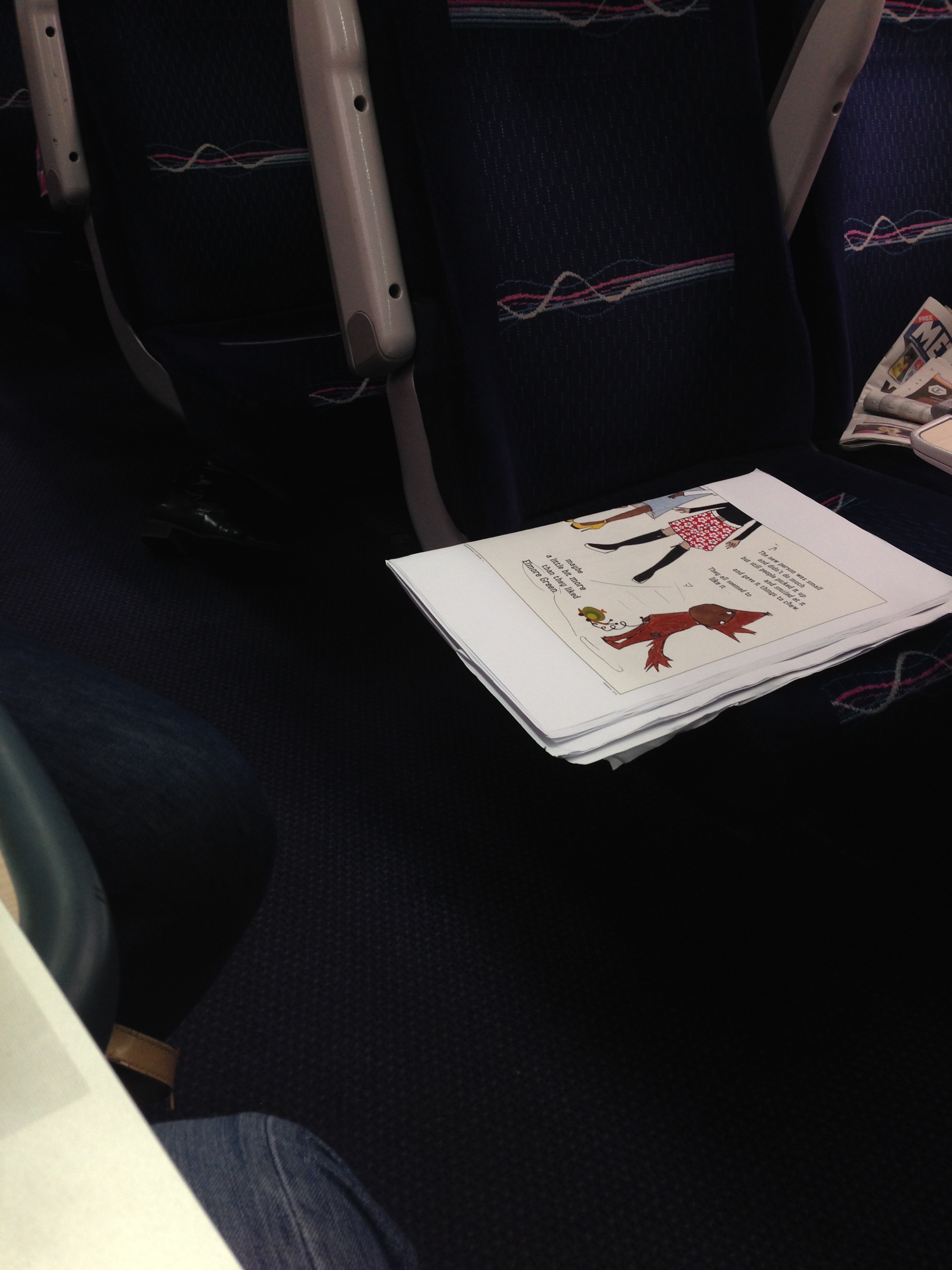
My most recent example was just last week, sitting opposite a woman who was working on her laptop and referring to a sheaf of A3 colourful papers. They had the unmistakable artwork of Lauren Child, a children’s author and illustrator. As a father of a ten year old and an eight year I recognised the artwork and style immediately as the author of Charlie and Lola, some of my children’s favourite story characters. The papers in questions had plenty of hand drawn mark up on them suggesting this was in the final stages of editing and layout prior to printing, the story itself centering around one Elmore Green who was jealous at the arrival of a younger sibling into his family. It all ends well of course, with Elmore having someone to snuggle with at the end of  the book.

Three things surprised me. Firstly, the way in which the papers in question were left out of the direct sight of the woman concerned, either on a seat on the opposite side of the walkway, or even underneath her own seat (and very accessible from behind). Secondly I was able to discern a large amount of detail from the book in a very short period of time; this is of course partly down to the nature of the book itself, but also, because each page was carefully moved to in turn and then placed somewhere I could review it and even photograph it. Finally, I was alarmed that someone like Lauren Child, who has a very unique and successful place in children’s literature would allow an as yet unpublished book be revealed in public in such a way as this.

Fingers crossed for Elmore Green!

Fingers crossed for Elmore Green!

This is of course very serious for Lauren Child and her publishers; why was this person allowed to take large copies of this book into a public space? If they knew it needed to be worked on in a train or other public space why weren’t electronic versions made available? Or had they even considered the fact that someone could have easily stolen the manuscript and copied it for an earlier release to capture their particular market?

The implications for UK PLC are probably not that great, and yet examples like this are played out across the country whenever people travel and feel they are in ‘safe‘ environments, with a dangerous cumulative effect for the country. The combined effect of actions like this could potentially add up to the millions in lost opportunities and lost work.  It reminded me of Wendy Nather’s response to a question about public apathy to security, and her surprising yet eerily accurate response was;

I don’t think that society in general will stand up and do something about security until people start dying in enough numbers that it could happen to them individually and not just organizations because we don’t care about organizations.

I sincerely hope Lauren Child has not been hurt by this incident financially or otherwise, she has given too much joy to my children to wish that; but if she reads this I do hope she feels sufficiently motivated to insist on stronger controls around the management of her manuscripts from her publishers.  If you would like some help doing that Lauren, feel free to contact me!


Cross Post – The Human Element

(Originally posted on the Iron Mountain Information Advantage Blog, November 20 2013.)

lost-keys1Leaving things on the train or in a restaurant, or in fact anywhere is an unpleasant fact of life for many of us. I would guess that almost all the readers of this blog have at some point left their keys, wallet, shopping, hat, gloves, children, scarf or phone somewhere or other. On occasion, such lapses in concentration can be upsetting, costly, or embarrassing and in some rare instances even dangerous. But in most cases what we leave behind is either easily replaceable (gloves), insured/covered (bank cards) or worth the cost to change and replace (keys). It’s very rare that we leave and lose something irreplaceable (presumably you found the kids!). This is because the items we treasure often have significant intrinsic and/or emotional value. A good example would be family heirlooms, passed down from generation to generation; we treasure them and therefore take care to protect them, storing them in a safe (or at least a safe place) to be taken out only on special occasions.

What about leaving data somewhere? It wasn’t so long ago, that civil servants and the MOD were criticised frequently in the media for leaving highly sensitive and valuable data exposed in public places. Rarely, it seemed, did a day go by without the Daily Mail bemoaning the inability of the public sector to protect our data. Headlines called for heads to roll. And yet, invariably, these were just the kind of simple, human mistakes that every one of us have made in one way or other. These days, however, the vast majority of data is (or at least should be) encrypted, both when it is on the move and when it’s at rest. Consequently, the loss or theft of encrypted data may now raise fewer eyebrows.

Printed matter, however, is another thing entirely. You can’t encrypt paper documents, and paper is very difficult to secure during transport, without somehow physically attaching it to your person. Taking sensitive documents from one location to another, so often a necessity, quickly becomes a thing of peril. Conceptual drawings, designs, technical drawings, mock ups etc. will often need to be taken to a client site or a manufacturer, and sometimes cannot be sent electronically. After a successful pitch and a few celebratory drinks afterwards those documents could all too easily be left on the night bus to Neasden, unprotected and full of intellectual property and sensitive information. A breach like that can so easily turn a night of celebration into a morning of embarrassment and apologies, followed by the inevitable search for new clients.

Protecting printed documents is difficult, probably more difficult than electronic information, and yet we seem to put all of our efforts into the very latest and best encryption, protected USB keys, and expensive data loss prevention (DLP) initiatives. It’s easier to put in place a technology, especially a “transparent” one than it is to change behaviours.

I would suggest that the information security community needs to address this disparity; the paperless office hasn’t transpired, the digital documents are secured, but paper has been left behind. How can we address this without handcuffing briefcases to people? As usual, it has to come down to awareness, we need to drive home the message that paper should be transported with the same care as electronic records, observing sensible procedures such as ensuring there are always two people present when travelling with paper (to act as more of a reminder than as a physical protection) or even only couriering them with a specially selected and reviewed vendor.

I don’t want to turn the Chief Information and Security Officer into a George Smiley type character, but I do want all of our sensitive records to be treated with the same level of protection irrespective of format.